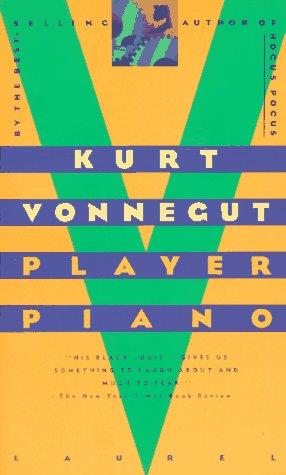
Player Piano
Kurt Vonnegut (1952)
“A prescient satire about machines replacing human labor, written by a man who watched it happen at General Electric.”
Player Piano— Summary & Analysis
by Kurt Vonnegut · published 1952 · 341 pages · Dystopian / Early Postmodern
A user-friendly study guide for Player Piano by Kurt Vonnegut (1952): a high-level plot summary, full chapter-by-chapter analysis, theme breakdowns, character profiles, and essay questions designed for high-school, ap-english, college readers. Unlike a stock summary, sumsumsum.com adds a diction analysis drawn from Kurt Vonnegut’s actual text, the 2 documented AP Literature exam appearances of this book, and reading-difficulty guidance (Easy, 3/10) so students, teachers, and lifelong readers know what they are walking into.
“A prescient satire about machines replacing human labor, written by a man who watched it happen at General Electric.”
Short Summary
In the near-future city of Ilium, New York, Dr. Paul Proteus is a privileged engineer-manager in a society where machines have replaced nearly all human labor. Workers live across the river in Homestead, stripped of purpose and dignity. The Shah of Bratpuhr, a foreign dignitary, tours America and sees what its citizens cannot: that ordinary people have been reduced to slaves of the machine. Paul grows disillusioned with his role in the system, joins the underground Ghost Shirt Society, and leads a doomed rebellion. The revolution briefly succeeds in Ilium before the rebels instinctively begin rebuilding the machines they just destroyed. Paul surrenders, recognizing that the human addiction to technological progress may be unbreakable.
Detailed Summary
In a near-future America, the Second Industrial Revolution has automated virtually all manufacturing and most intellectual labor. Society is divided into three rigid castes: the engineers and managers who design and oversee the machines, the military, and everyone else — the vast majority, who live ...
Summary in the Author’s Writing Style
A retelling of Player Piano in Kurt Vonnegut’s style — so you can hear the language, not just the plot. This is a stylistic pastiche written by sumsumsum, not an excerpt from the book.
Across the river from Homestead stood the Ilium Works, and the Works hummed along very nicely without anyone touching it, which was, after all, the whole idea. Machines did the work now. Machines did it cheaply and they did it without complaint and they never came in late with whiskey on their breat…
More from Kurt Vonnegut and the scholars who study Vonnegut
Other works by Kurt Vonnegut: Breakfast of Champions (1973, 302 pages), Cat's Cradle (1963, 287 pages), Slaughterhouse-Five (1969, 275 pages). Reading two or three of these in sequence reveals Kurt Vonnegut’s recurring obsessions and stylistic signatures more clearly than any single book can.