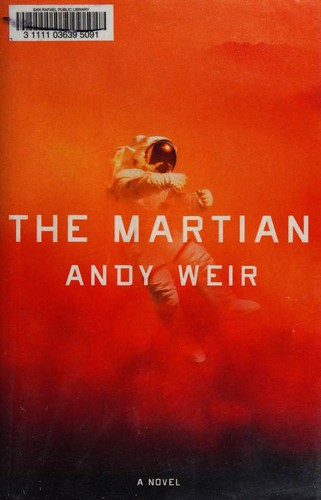
The Martian
Andy Weir (2014)
“A stranded astronaut does math to stay alive on Mars, and makes you laugh while he does it.”
The Martian— Historical Context & Author Background
Author: Andy Weir · Published 2014· Era: Contemporary·369 pages
Themes explored: survival, science, problem-solving, isolation, human-ingenuity, cooperation, humor
About Andy Weir
Andy Weir (b. 1972) is the son of a particle physicist and an electrical engineer. A self-described 'nerd' who grew up reading Asimov and Clarke, he worked as a computer programmer at Sandia National Laboratories and AOL before writing fiction. He wrote The Martian as a serial on his personal website, posting chapters for free and incorporating technical feedback from scientists and space enthusiasts who became his earliest readers. When readers requested a Kindle version, he self-published on Amazon at $0.99 — the minimum price. It became the bestselling book on Amazon in 2013. Crown Publishing acquired it in 2014; Ridley Scott's film adaptation, starring Matt Damon, grossed $630 million worldwide in 2015. Weir's subsequent novels — Artemis (2017) and Project Hail Mary (2021) — confirm his commitment to scientifically rigorous, character-driven science fiction.
Life → Text Connections
How Andy Weir's real experiences shaped specific elements of The Martian.
Weir's parents are both scientists; he grew up in an environment where problem-solving was the default response to difficulty
Watney's unshakeable faith that every problem has a solution if you apply the right science
The novel's epistemology — science as salvation — is autobiographical. Weir does not merely believe science works; he was raised in it.
Weir self-published chapter by chapter, incorporating reader feedback on the science
The novel's unusual technical accuracy — the chemistry, botany, orbital mechanics, and engineering have been vetted by domain experts
The collaborative production mirrors the novel's theme: Watney survives through collective effort, and the novel itself was refined through collective expertise.
Weir worked as a programmer, not an astronaut or scientist, and taught himself orbital mechanics and botany for the novel
Watney's cross-disciplinary competence — he draws on botany, chemistry, engineering, and physics despite being primarily a botanist
The autodidact's faith that any field can be learned well enough to apply under pressure. Weir proved it by writing the book; Watney proves it by surviving.
The self-publishing-to-bestseller trajectory was itself a long-shot success story
The novel's optimism about human perseverance and the power of doing the work even when the odds are catastrophic
Weir's career arc mirrors Watney's survival arc: both succeeded by being methodical, persistent, and unwilling to accept failure as final.
Historical Era
Post-Space Shuttle, pre-Artemis — the era of Mars curiosity and commercial spaceflight
How the Era Shapes the Book
The Martian was written during a period when Mars had returned to public consciousness through rover missions but no crewed mission was on the horizon. This gap between aspiration and capability creates the novel's emotional context — readers wanted to go to Mars and couldn't, so a story about surviving there resonated with unusual force. The novel's insistence on real science, published during an era of growing science skepticism, functioned as both entertainment and implicit advocacy for scientific literacy.
Why The Martian Matters Historically
Demonstrated that hard science fiction — fiction built on real, verifiable science — could achieve mainstream bestseller status without sacrificing technical rigor. The self-publishing origin story became a case study in digital-era publishing. The novel revived public interest in Mars exploration and was cited by NASA administrators as a recruitment tool. It proved that scientific problem-solving could function as narrative entertainment, not merely as backdrop.
- One of the first self-published novels to be acquired by a major publisher and adapted into a major film
- Pioneered the 'competence thriller' subgenre — tension derived from detailed problem-solving rather than antagonists
- One of the first novels to be publicly vetted for scientific accuracy by its readership before traditional publication
Challenged in some school districts for pervasive profanity, particularly the frequent use of the f-word. The irony — a novel celebrating scientific literacy removed from schools for language — has itself become a talking point about censorship priorities.