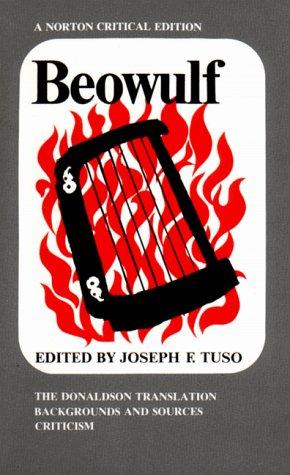
Beowulf
Anonymous (Old English poet) (1000)
“The oldest surviving epic poem in English — a warrior kills monsters, becomes king, fights a dragon, and dies asking whether any of it mattered.”
Beowulf— Historical Context & Author Background
Author: Anonymous (Old English poet) · Published 1000· Era: Medieval·120 pages
Themes explored: courage, honor, fate, good-vs-evil, mortality, legacy, loyalty
About Anonymous (Old English poet)
The author of Beowulf is unknown. The poem survives in a single manuscript — British Library Cotton MS Vitellius A.xv — copied around 1000 CE by two scribes, but the poem itself was likely composed much earlier, perhaps as early as the 7th or 8th century. Whether it was composed orally and later transcribed, or composed in writing by a literate poet working within oral traditions, is one of the most debated questions in medieval studies. What is clear: the poet was a Christian writing about a pagan past, deeply versed in both Germanic heroic tradition and Latin biblical learning. The poem is set in Scandinavia — Denmark and southern Sweden — but was composed in England, probably in an Anglo-Saxon court. The poet never names himself, which was standard for Old English poetry. The manuscript survived a devastating fire in 1731 at Ashburnham House that destroyed or damaged hundreds of manuscripts in the Cotton library; the edges of the Beowulf manuscript are charred, and some readings are only recoverable from transcriptions made before the fire.
Life → Text Connections
How Anonymous (Old English poet)'s real experiences shaped specific elements of Beowulf.
The anonymous poet was a Christian writing about pagan ancestors — ancestors the Anglo-Saxons revered but whose religion they had rejected
The poem's narrator repeatedly references the Christian God and calls Grendel a descendant of Cain, while the characters themselves pray to pagan deities and never mention Christ
This creates the poem's central interpretive tension. The poet admires his pagan heroes — their courage, loyalty, and generosity — but knows they are damned because they never knew the Christian God. The result is a poem of deep moral ambivalence.
J.R.R. Tolkien's 1936 lecture 'Beowulf: The Monsters and the Critics' revolutionized scholarship by arguing the poem should be read as a work of art, not merely a historical document
Before Tolkien, scholars treated Beowulf primarily as a source for Anglo-Saxon history and language. Tolkien insisted the monsters were the point — that the poem's structure (two monster fights in youth, one in old age ending in death) was a deliberate artistic design about the arc of human life
Tolkien essentially rescued Beowulf for literary studies. His argument that the poem is about mortality — 'man at war with the hostile world and his inevitable overthrow in Time' — remains the dominant framework for reading it.
The Cotton Library fire of 1731 nearly destroyed the only surviving manuscript
The charred edges of Cotton Vitellius A.xv mean that some words and passages are permanently lost, recoverable only from earlier transcriptions by Humphrey Wanley and Grimmur Jonsson Thorkelin
The poem's survival is itself an epic narrative of precariousness. That the entire tradition of English epic poetry rests on a single scorched manuscript underscores the poem's own themes of impermanence and the fragility of human achievement.
Seamus Heaney's 1999 translation won the Whitbread Prize and made Beowulf a bestseller — the first Old English poem to appear on contemporary bestseller lists
Heaney, an Irish poet, chose to inflect his translation with the dialect of his Northern Irish upbringing, using words like 'bawn' and 'thole' that carry both Old English and modern Hiberno-English resonance
Heaney's translation demonstrated that Beowulf is not a museum piece but a living poem capable of speaking to modern readers. The translation debate — Heaney vs. scholarly accuracy vs. other poets' versions — reflects the ongoing argument about who owns the poem and what it means.
The poem was set in Scandinavia but composed in England, reflecting the Anglo-Saxons' awareness of their own migration history from the Continent
The Geats, Danes, and Swedes of the poem are the poet's own ancestral peoples — the Germanic tribes who migrated to Britain in the 5th and 6th centuries
Beowulf is a poem about the old country, composed in the new one. It preserves tribal memories of a Scandinavian past that the Anglo-Saxons had left behind but not forgotten, giving the poem a nostalgic, backward-looking quality that aligns with its elegiac tone.
Historical Era
Anglo-Saxon England (c. 700-1000 CE) — composition; Migration-era Scandinavia (c. 500-600 CE) — setting
How the Era Shapes the Book
Beowulf was composed during the period when Anglo-Saxon England was negotiating between its Germanic pagan past and its Christian present. The poem's characteristic tension — admiring pagan heroism while acknowledging Christian cosmology — reflects a culture in transition. The comitatus bond, the mead-hall as social center, the gift economy, and the blood-feud system all reflect historical Germanic social organization. But the poet's references to God, Cain, and divine judgment reflect the Latin Christian education that Anglo-Saxon monastic culture had brought to the island. The poem is the artistic product of a society that had one foot in the pagan world of its ancestors and one foot in the Christian present.
Why Beowulf Matters Historically
Beowulf is the oldest surviving long poem in English literature and the single most important text in Old English. It is the foundation of the English literary tradition — the starting point for any history of literature in English. Beyond its linguistic significance, it is a masterpiece of narrative structure, a profound meditation on mortality and the limits of heroism, and the text that influenced J.R.R. Tolkien so deeply that modern fantasy literature is inconceivable without it.
- The oldest surviving epic poem in English — predating Chaucer by approximately four centuries
- The first major literary work to explore the tension between pagan heroism and Christian morality in English
- The foundational text for the study of Old English language and literature
- The first English poem to present a fully realized tragic hero — a warrior who wins every battle but cannot defeat time
- The source text that inspired Tolkien's theory of the 'Northern courage' — the idea that the hero fights knowing he will ultimately lose
Beowulf has not been banned but has been subjected to a different kind of suppression: scholarly neglect. For centuries, the poem was treated as a linguistic artifact rather than a work of literature — a source of vocabulary and grammar, not a story worth reading for its own sake. Tolkien's 1936 lecture 'Beowulf: The Monsters and the Critics' argued that this was a fundamental misunderstanding, that the poem was art, and that scholars had been studying everything about Beowulf except the poem itself. This argument effectively rescued the text from its own academic tradition.