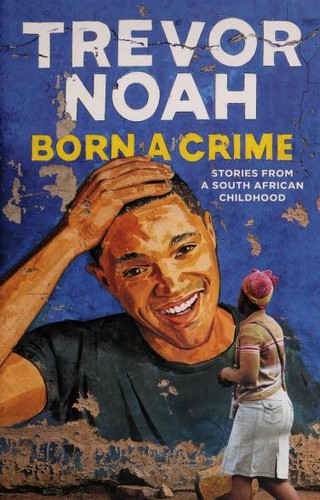
Born a Crime— Historical Context & Author Background
Author: Trevor Noah · Published 2016· Era: Contemporary / Memoir·304 pages
Themes explored: race, identity, language, family, apartheid, humor, resilience, belonging
About Trevor Noah
Trevor Noah was born on February 20, 1984, in Johannesburg, South Africa, to Patricia Nombuyiselo Noah (Xhosa) and Robert Noah (Swiss-German). Under the Immorality Act and the Prohibition of Mixed Marriages Act, their relationship was criminal and his birth was illegal. He grew up in Soweto and the Johannesburg suburbs during the final years of apartheid and the turbulent post-apartheid transition. He began performing stand-up comedy in South Africa in his early twenties, became a television personality there, and was announced as Jon Stewart's successor on The Daily Show in 2015 — a month before Born a Crime was published. He is now one of the most recognizable comedians in the world. Patricia Noah — the book's true subject — was shot in the head by her second husband Abel Shingange in 2009. She survived.
Life → Text Connections
How Trevor Noah's real experiences shaped specific elements of Born a Crime.
Noah's birth was literally illegal under apartheid law
The title and opening chapters — the entire framing of his existence as a crime
The book is not using 'born a crime' as metaphor or hyperbole. It is precise legal description. That precision is the memoir's first and most important move.
Noah grew up speaking six or more languages, moving between racial communities that apartheid had designed to be sealed from each other
The 'Chameleon' chapter and the recurring theme of language as survival technology
His linguistic fluency was not a gift or a curiosity — it was a deliberate maternal strategy for survival in a system that would otherwise trap him.
Patricia Noah was shot twice in the head by Abel Shingange in 2009 and survived
The final chapters about Abel's violence and Patricia's survival
The memoir's emotional climax is drawn from a real, recent event. The survivor's comedy — Patricia cracking jokes in the hospital — is not fictional. It is how Patricia Noah actually responded.
Noah became Jon Stewart's Daily Show successor in 2015, an appointment that surprised American audiences who didn't know him
The memoir was partly an introduction — a formal account of who this person is and where he came from
Born a Crime functions as both personal reckoning and public self-introduction. It explains Noah to audiences who only knew him as a performer.
Historical Era
South Africa 1984-2009 — final years of apartheid (ended 1994), post-apartheid transition, Mandela presidency, democratic consolidation
How the Era Shapes the Book
Apartheid is not background in this memoir — it is the mechanism. Every chapter of Trevor's childhood is shaped by the Immorality Act, the pass book system, the racial classification bureaucracy, and the geographic segregation of townships. When apartheid ends in 1994, it ends legally but not socially or economically, which is why the post-apartheid sections feel almost as constrained as the apartheid sections. The freedom changes the law but not the world the law built.
Why Born a Crime Matters Historically
Born a Crime was published in 2016 and became a #1 New York Times bestseller. It is one of the most widely read accounts of apartheid from inside the experience — not from an activist or a political figure but from a child who lived it as ordinary life. It introduced apartheid South Africa to millions of readers who had no prior engagement with the subject, via comedy rather than solemnity. For many younger American readers, it was the first book about South Africa they voluntarily read.
- One of the first mainstream American-market books about apartheid's daily texture told from the perspective of a child of mixed race
- Among the first celebrity memoirs that functions as serious historical literature — the comedy doesn't dilute the history, it makes it more accessible
- Introduced the concept of language-based code-switching as apartheid survival strategy to a broad non-specialist audience
Has faced challenges in some school districts for language (including a slur used documentarily), depictions of violence and abuse, and content around sexuality and teen experience. Challenges tend to focus on individual scenes rather than the book's historical and political substance.