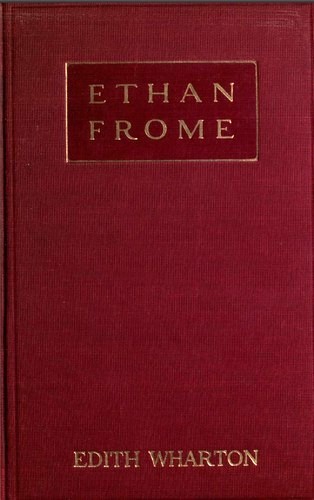
Ethan Frome
Edith Wharton (1911)
“A tale of desire buried under ice and duty — written by a woman trapped in her own marriage, about a man who couldn't escape his.”
Ethan Frome— Historical Context & Author Background
Author: Edith Wharton · Published 1911· Era: American Realism·195 pages
Themes explored: isolation, duty, desire, entrapment, nature, class, fate
About Edith Wharton
Edith Wharton (1862-1937) was born Edith Newbold Jones in New York City into one of the oldest and wealthiest families in America — the family so prominent that the phrase 'keeping up with the Joneses' is attributed to them. She married Edward ('Teddy') Wharton in 1885; the marriage was a disaster from nearly the beginning. Teddy suffered from mental illness and depression; Edith found intellectual companionship and eventually romantic love elsewhere, primarily with the journalist Morton Fullerton. She divorced Teddy in 1913, two years after Ethan Frome was published — an unusual and socially costly act for a woman of her class. She wrote Ethan Frome from the comfortable distance of her Lenox, Massachusetts estate (The Mount) and later from Paris, where she had largely relocated. The irony is precise and uncomfortable: Wharton, one of the wealthiest women in America, wrote the definitive portrait of rural poverty and marital entrapment while herself engineering an escape her characters could never afford.
Life → Text Connections
How Edith Wharton's real experiences shaped specific elements of Ethan Frome.
Wharton's marriage to Teddy was emotionally and physically dead for years; she stayed out of social obligation and the lack of an acceptable alternative
Ethan's marriage to Zeena — entered not from love but from obligation, continued not from affection but from the absence of an exit
Wharton knew from the inside what it felt like to be trapped in a marriage by forces more powerful than individual will. The novel's portrait of marital imprisonment is autobiographically inflected even as its social circumstances are reversed.
Wharton was extraordinarily wealthy but also acutely class-conscious — she understood how money was the mechanism of freedom, and its absence was the mechanism of entrapment
Ethan's inability to leave is finally and specifically financial — no money for train tickets, no money for a new start, the farm mortgaged beyond recovery
Wharton chose to write from the perspective of poverty's constraint, which she had never experienced, with full analytical understanding of how money operates as a lever of liberty. Her wealth gave her the distance to see what poverty does that poverty itself cannot narrate.
Wharton originally wrote the beginning of Ethan Frome in French as a language exercise and then developed it into the full novel
The frame narrative's constructed, assembled quality — the story pieced together from fragments — reflects the original compositional act of translation and reconstruction
The novel's form (a story told at two removes, in fragments) may reflect its genesis in a language exercise — something built from limited material into the shape of a larger truth.
Wharton spent time in the Berkshires and Lenox area, observing rural New England life from her estate, The Mount
Starkfield's landscape — the specific cold, the specific architecture, the specific silence — is rendered with the precision of extended observation rather than imagination
Wharton's proximity to rural poverty without membership in it gave her the anthropologist's double vision: close enough to see accurately, removed enough to analyze structurally.
Historical Era
Late 19th / early 20th century New England — the end of the agrarian world
How the Era Shapes the Book
Ethan Frome is set in a dying world. The rural New England economy that produced the Frome farm was already obsolete by 1911 — the young had left, the farms were failing, the old ways of silent endurance were becoming the inheritance of those who couldn't escape. Wharton understood this historically: Starkfield is contracting not just meteorologically but economically and demographically. The trap that holds Ethan is not merely psychological or moral — it is the specific product of a historical moment when an entire agrarian civilization was failing and the people left inside it had no resources to transition.
Why Ethan Frome Matters Historically
Ethan Frome has been continuously in print since 1911 and is one of the most taught American novels at the high school and college level. Initially controversial for its unflinching portrait of marital misery and failed suicide, it is now recognized as one of the defining texts of American literary realism and one of Wharton's finest formal achievements. Its brevity — under 200 pages — made it accessible as a classroom text; its depth rewards advanced study.
- One of the earliest American novels to treat rural poverty with the same analytical attention previously given to upper-class society
- Among the first major works to use a sophisticated frame narrative to create dramatic irony — the reader knows the outcome before the story begins
- Pioneered the use of landscape as moral and psychological character — the New England winter as active agent, not backdrop
Challenged periodically for its treatment of suicide and implied sexual desire. Some early critics objected to the novel's portrayal of marriage and found its bleak determinism un-American — a charge Wharton would have found both predictable and amusing.