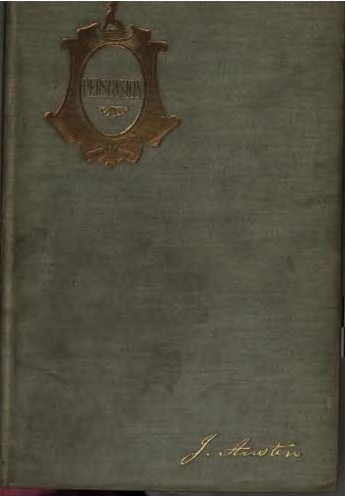
Persuasion
Jane Austen (1817)
“A love story about a woman who made the wrong choice at nineteen and spends eight years paying for it — until the man she rejected writes the most devastating letter in English literature.”
At a Glance
Anne Elliot, now twenty-seven, lives quietly in the shadow of her vain, spendthrift family. Eight years ago she broke off her engagement to Frederick Wentworth — a young naval officer of no fortune — on the advice of her family friend Lady Russell. Wentworth has since made his name and fortune in the Navy. When he returns to the neighborhood, the two are thrown together constantly, and Anne must endure his apparent indifference and attentiveness to other women while concealing feelings that never faded. The novel climaxes with Wentworth's letter — written in real time as he listens to Anne argue for the constancy of women's love — and their reunion in the streets of Bath.
Read full summary →Why This Book Matters
Published posthumously in December 1817, six months after Austen's death. Initially less celebrated than Pride and Prejudice or Emma, Persuasion acquired its reputation gradually over the nineteenth and twentieth centuries as readers and critics recognized it as Austen's most emotionally mature and personally revelatory work. C.S. Lewis called it her 'most serious' novel. Virginia Woolf read it as Austen's transition point — the moment she might have moved into a new mode entirely had she lived. Wentworth's letter is now one of the most anthologized passages in English literature.
Diction Profile
Formal Regency prose with deep interiority — Austen's most psychologically intimate register, closer to the interior monologue than her earlier novels
Moderate but highly targeted. Austen avoids the metaphor-density of Romantic poetry; her figurative language lands with precision because it is infrequent. The autumnal imagery of the novel's opening section