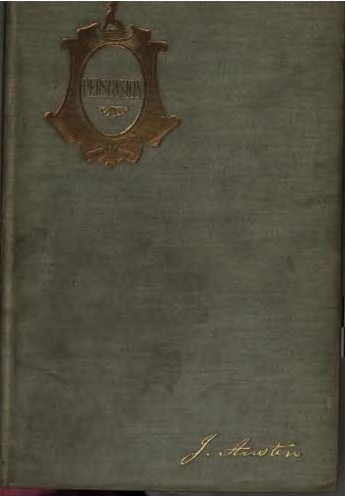
Persuasion
Jane Austen (1817)
“A love story about a woman who made the wrong choice at nineteen and spends eight years paying for it — until the man she rejected writes the most devastating letter in English literature.”
Persuasion— Summary & Analysis
by Jane Austen · published 1817 · 249 pages · Romantic / Regency
A user-friendly study guide for Persuasion by Jane Austen (1817): a high-level plot summary, full chapter-by-chapter analysis, theme breakdowns, character profiles, and 30 essay questions designed for ap-english, college, ib readers. Unlike a stock summary, sumsumsum.com adds a diction analysis drawn from Jane Austen’s actual text, the 8 documented AP Literature exam appearances of this book, and reading-difficulty guidance (Easy, 3/10) so students, teachers, and lifelong readers know what they are walking into.
“A love story about a woman who made the wrong choice at nineteen and spends eight years paying for it — until the man she rejected writes the most devastating letter in English literature.”
Short Summary
Anne Elliot, now twenty-seven, lives quietly in the shadow of her vain, spendthrift family. Eight years ago she broke off her engagement to Frederick Wentworth — a young naval officer of no fortune — on the advice of her family friend Lady Russell. Wentworth has since made his name and fortune in the Navy. When he returns to the neighborhood, the two are thrown together constantly, and Anne must endure his apparent indifference and attentiveness to other women while concealing feelings that never faded. The novel climaxes with Wentworth's letter — written in real time as he listens to Anne argue for the constancy of women's love — and their reunion in the streets of Bath.
Detailed Summary
Anne Elliot is the middle daughter of Sir Walter Elliot, a vain baronet of Kellynch Hall, Somerset, whose vanity and extravagance have brought the family to the edge of bankruptcy. Sir Walter's eldest daughter Elizabeth is her father's mirror; the youngest, Mary, is married to the respectable Charle...
Summary in the Author’s Writing Style
A retelling of Persuasion in Jane Austen’s style — so you can hear the language, not just the plot. This is a stylistic pastiche written by sumsumsum, not an excerpt from the book.
Sir Walter Elliot of Kellynch Hall, in Somersetshire, was a man who required no other book than the Baronetage and no other society than his own reflection; and if his estate was sinking under the weight of his elegance, that was a misfortune to be borne by everyone but himself. His eldest daughter,…
Chapter-by-Chapter Analysis
If you liked Persuasion, read next
Start with The Age of Innocence by Edith Wharton — Another novel about the cost of choosing social propriety over feeling — Newland Archer is Anne Elliot's male counterpart, though Wharton refuses Austen's second chance. Or pivot to Middlemarch by George Eliot — Dorothea Brooke's interiority is the fullest realization of what Austen's free indirect discourse begins — the interior life of a woman too intelligent for her social world.
For comparative essays, pair Persuasion with
The strongest comparative pairing is North and South (Elizabeth Gaskell) — The closest Victorian parallel — Margaret Hale and Thornton's delayed love story carries the same structure of misunderstanding overcome, with comparable class tensions. For a third angle, contrast with The Remains of the Day (Kazuo Ishiguro) — The most direct modern descendant of Persuasion's emotional architecture — a narrator who sacrificed feeling for duty, discovering too late what it cost, with far less hope of recovery.
Each of these pairings opens a clean thesis path on shared themes, period diction, or formal influence — useful for AP Lit / IB / first-year college comparative essays.
More from Jane Austen and the scholars who study Austen
Other works by Jane Austen: Emma (1815, 474 pages), Mansfield Park (1814, 483 pages), Northanger Abbey (1817, 260 pages), Pride and Prejudice (1813, 432 pages). Reading two or three of these in sequence reveals Jane Austen’s recurring obsessions and stylistic signatures more clearly than any single book can.
The standard scholarly entry points to Jane Austen’s work: Claudia L. Johnson (Princeton, Murray Professor of English) — Jane Austen: Women, Politics, and the Novel (1988); Mary Lascelles (Oxford, Somerville College) — Jane Austen and Her Art (1939); Lionel Trilling (Columbia, Trilling lectures on Austen) — The Opposing Self (1955). These are the works graduate seminars cite when teaching Jane Austen.