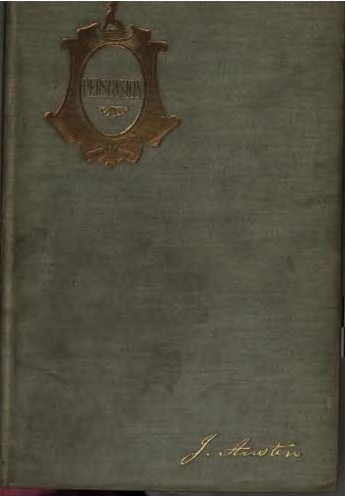
Persuasion
Jane Austen (1817)
“A love story about a woman who made the wrong choice at nineteen and spends eight years paying for it — until the man she rejected writes the most devastating letter in English literature.”
Persuasion— Literary & Historical Significance
Why This Book Matters
Published posthumously in December 1817, six months after Austen's death. Initially less celebrated than Pride and Prejudice or Emma, Persuasion acquired its reputation gradually over the nineteenth and twentieth centuries as readers and critics recognized it as Austen's most emotionally mature and personally revelatory work. C.S. Lewis called it her 'most serious' novel. Virginia Woolf read it as Austen's transition point — the moment she might have moved into a new mode entirely had she lived. Wentworth's letter is now one of the most anthologized passages in English literature.
Firsts & Innovations
The earliest sustained use of free indirect discourse as a primary narrative technique in English fiction — Austen's interiority here points directly toward the stream of consciousness novel
One of the first major English novels to take as its subject not the first experience of love but its recovery — the love story of adults with history, not young people with innocence
Persuasion introduced the autumnal novel — the mode of looking back, of regret redeemed, of time as the primary emotional substance
Cultural Impact
Wentworth's letter is cited in marriage proposals, quoted at weddings, and appears more frequently in popular culture than almost any other passage from Austen's work
Anne Elliot is consistently rated the most fully realized of Austen's heroines by Austen scholars, precisely because she lacks Emma's blind spots and Elizabeth's sharpness — she is simply good, which is harder to write
The novel's central question — was it right to be persuaded? — has generated more sustained critical debate than any other Austen ethical question
The Cobb at Lyme Regis became a literary pilgrimage site; the steps where Louisa fell are marked and visited
The phrase 'half agony, half hope' entered the language as shorthand for the suspended state of love without certainty
Banned & Challenged
Not banned. Persuasion was too quiet and too late to generate the kind of controversy that attaches to louder books. It was, instead, underread — an irony Austen would have recognized.