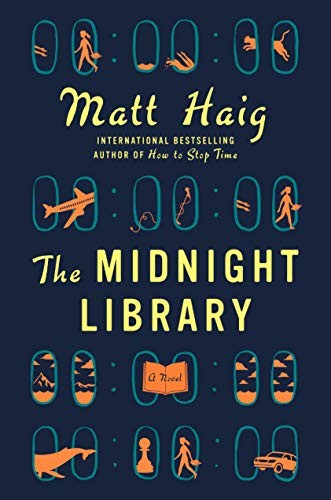
The Midnight Library
Matt Haig (2020)
“A suicidal woman discovers a library between life and death where every book is a life she could have lived — and none of them are what she expected.”
Essay Questions & Food for Thought
30questions designed to challenge assumptions and provoke original thinking. These can't be answered from a summary — you need the actual text.
Why does Haig choose a librarian as Nora's guide rather than a therapist, a priest, or a family member? What does the choice of profession reveal about the novel's values?
The Midnight Library literalizes a metaphor — turning regret into a book and alternate lives into physical spaces. What does this gain? What does it lose compared to a realistic novel about depression?
Nora's Book of Regrets catalogs every choice she wishes she had made differently. If you had a Book of Regrets, would it be thick or thin? Does the exercise of imagining it change your relationship to your actual choices?
The Dan marriage is revealed as miserable within hours. Is Haig being fair to the concept of 'the one who got away,' or is he stacking the deck? Could the Dan life have been good?
Compare the Midnight Library to It's a Wonderful Life. Both show a suicidal character alternate versions of reality. How are their arguments different? Which is more honest?
The rock star life offers genuine creative fulfillment alongside genuine destruction. Is Haig arguing that ambition itself is dangerous, or only that ambition without balance is?
Nora's philosophy degree is repeatedly referenced. Why does Haig give his protagonist a philosophical education that cannot save her? Is the novel arguing against philosophy?
The Molly chapter is the novel's most emotionally powerful section. Why does parental love succeed in engaging Nora where romantic love, friendship, and career success all failed?
The novel uses quantum mechanics (many-worlds interpretation) as its speculative framework. How seriously should we take the science? Does the novel need it, or is it decorative?
Haig published this novel during the COVID-19 pandemic. How would the novel read differently if it had been published in 2015? What did the pandemic add to its reception?
Mrs. Elm says 'The only way to learn is to live.' But Nora learns by trying lives she doesn't keep — which is closer to reading than living. Does the novel undermine its own thesis?
Every alternate life Nora enters contains suffering. Is Haig arguing that suffering is inescapable, or merely that suffering is not a reason to stop living? Is there a difference?
The novel has been criticized as 'self-help disguised as fiction.' Is this a fair criticism? Does the novel do something that a self-help book cannot?
Nora's root life has not changed when she returns to it. The cat is still dead. The job is still gone. What, exactly, has changed? How does internal change matter if external circumstances remain the same?
Compare Nora Seed to Ebenezer Scrooge. Both are shown alternate realities by supernatural guides and choose to change. Is Haig writing a modern Christmas Carol? What are the key differences?
The novel suggests that the geographic cure (moving somewhere beautiful to solve unhappiness) does not work. Do you agree? Is there no version of Nora's life where location genuinely matters?
Why does the library collapse? What would happen to the novel's argument if Nora could stay there forever, trying lives indefinitely?
Haig's prose is deliberately simple — short sentences, common vocabulary, minimal figurative language. How does this stylistic choice serve the novel's themes? Could the same story be told in dense, literary prose?
The novel has been adopted by mental health organizations as a therapeutic tool. Is fiction a legitimate form of therapy? Can a novel change someone's relationship to their own depression?
If you could open one book in the Midnight Library — one alternate life — which choice would you revisit? After reading the novel, do you still want to?
Nora is a white, educated, British woman. How would the novel change if its protagonist were a different race, class, or nationality? Are there lives for whom the novel's argument — 'your root life is sufficient' — might feel inadequate?
The novel ends without resolving Nora's external problems — no new job, no reconciliation with Joe, no new relationship. Why does Haig refuse to provide conventional narrative closure?
Compare The Midnight Library to Groundhog Day. Both protagonists repeat experience until they learn to value what they have. Is repetition itself the teaching mechanism?
Haig references Thoreau's Walden: 'I went to the woods because I wished to live deliberately.' How does Nora's journey parallel and diverge from Thoreau's experiment?
The many-worlds interpretation implies that every possible Nora is real — the swimmer, the rock star, the mother. If all versions are equally real, why does the root life matter more?
Is Mrs. Elm a character, a function, or a projection of Nora's psyche? What evidence supports each interpretation?
The novel's title is The Midnight Library, not 'Nora's Choice' or 'The Book of Lives.' Why does Haig center the setting rather than the character? What does midnight signify?
Haig wrote Reasons to Stay Alive (nonfiction) before this novel. How does The Midnight Library make an argument that nonfiction cannot? Is fiction more or less honest than memoir about mental health?
The novel implies that depression distorts perception — that Nora's assessment of her life as worthless is a symptom, not a truth. Is the novel gaslighting depressed readers, or liberating them?
If Nora had found a perfect life in the library — one with no suffering, no regret, no loss — would the novel's argument collapse? Does the argument require that all lives contain suffering?