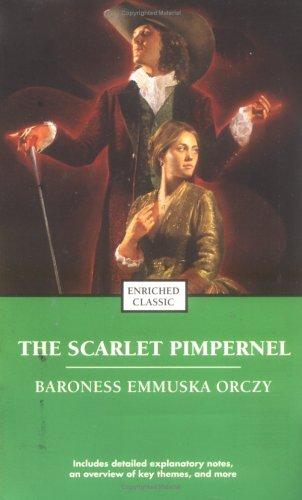
The Scarlet Pimpernel
Baroness Orczy (1905)
“The first superhero story — a bored English aristocrat puts on a disguise and humiliates the Reign of Terror, one rescued aristocrat at a time.”
Language Register
Victorian formal in narration, with aristocratic social comedy in dialogue and theatrical urgency in action scenes
Syntax Profile
Long, exclamation-heavy sentences in emotional scenes — Orczy's theatrical origins show in her punctuation. Action sequences shift to short declarative clauses. Percy's dialogue is deliberately over-inflated with interjections ('Odd's fish!', 'Demme!') that signal his performed personality. Chauvelin speaks in clipped, grammatically precise sentences that mirror his character.
Figurative Language
Moderate — Orczy uses light and darkness extensively (dawn, fog, candlelight, moonless nights). The red flower of the title appears in simile and metaphor throughout. Less dense than Fitzgerald or Hardy; the figurative language serves the thriller plot rather than the psychological depth.
Era-Specific Language
Euphemism for 'damned' — Percy's signature affectation, signals his performed aristocratic vapidity
Upper-class English address — compare Gatsby's borrowed use of the same term
Percy's informal network of English gentlemen volunteers, named for its badge
The Revolutionary tribunal responsible for the Reign of Terror
French form of address replacing aristocratic titles under the Revolution
How Characters Speak — Class & Identity
Sir Percy Blakeney
Two registers: the performed fool (exclamatory, self-deprecating, full of verbal tics) and the operational Pimpernel (spare, direct, exact). The gap between the two is the character.
Class performance as protective coloring. The English aristocracy's tolerance for eccentricity is weaponized as cover.
Marguerite Blakeney
French-accented elegance in social settings; more direct and less ornate in moments of stress. Her dialogue is the most natural in the novel.
An outsider to English aristocratic convention — her naturalness, her directness, her wit are un-English qualities that make her both admired and suspected.
Chauvelin
Formal, Latinate, bureaucratic. He speaks the language of the state — impersonal, procedural, without warmth.
The Revolution as institutional voice. Chauvelin does not have a personal idiom; he speaks the language of power.
Percy's League
Hearty, casual, English — the banter of men who treat mortal danger as sport.
English class confidence expressed as cheerful recklessness. They risk their lives because it doesn't occur to them that they might lose.
Narrator's Voice
Third-person omniscient with strong free indirect discourse — closest to Marguerite's interiority, more distant from Percy's (which preserves the mystery of his true identity). Orczy's narrator is warm, partisan, and occasionally breaks the fourth wall to address the reader directly.
Tone Progression
Chapters 1-7
Social comedy and romantic melancholy
The London world — glittering, witty, and subtly sad. The marriage is failing; the danger is still abstract.
Chapters 8-12
Thriller suspense and growing dread
The revelation, the chase, the crossing to France. Stakes clarify; comedy recedes.
Chapters 13-20
Urgent thriller resolving into romantic relief
The climax and resolution. Action prose gives way to the quietest writing in the novel for the reunion.
Stylistic Comparisons
- Alexandre Dumas — adventure-romance, noble heroes, elaborate disguises (The Three Musketeers, The Count of Monte Cristo)
- Conan Doyle — the clever hero playing a theatrical game against a tenacious opponent
- Georgette Heyer — Regency and Georgian romantic adventure, aristocratic heroes in historical settings
Key Vocabulary from This Book
Notable words used in this text — click to see full definitions