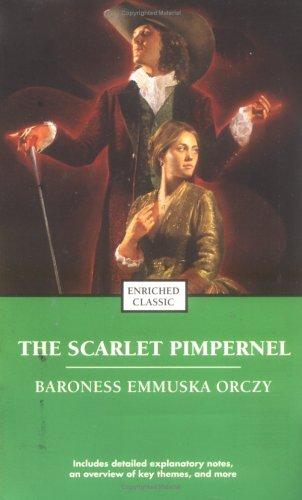
The Scarlet Pimpernel
Baroness Orczy (1905)
“The first superhero story — a bored English aristocrat puts on a disguise and humiliates the Reign of Terror, one rescued aristocrat at a time.”
Essay Questions & Food for Thought
30questions designed to challenge assumptions and provoke original thinking. These can't be answered from a summary — you need the actual text.
Percy hides his heroism behind a performance of stupidity. What does the novel suggest this kind of sacrifice costs him personally? Is it heroism or self-punishment?
Marguerite is described as 'the cleverest woman in England' — yet she fails to suspect Percy. Is this a flaw in the novel's logic, or does Orczy make it believable?
The Scarlet Pimpernel is often called the prototype of the modern superhero. List at least three specific elements of Percy's character that reappear in Batman, Zorro, or Spider-Man.
Chauvelin is a villain who is also genuinely competent, principled in his own way, and not personally cruel. How does making the antagonist admirable rather than purely evil change the novel?
Marguerite helped condemn the St. Cyr family to the guillotine — even though she believed she was protecting her brother. Is she morally responsible for their deaths? How does the novel judge her?
The novel presents the French Revolution purely as atrocity — the aristocrats are innocent victims, the revolutionaries are villains. Is this a fair historical representation? Does a novel have to be historically balanced to be a good novel?
Percy uses a Jewish merchant as one of his disguises, and Orczy's depiction reflects period antisemitism. How should a modern reader approach this element of the novel? Does it diminish the work?
The famous rhyme — 'We seek him here, we seek him there' — is sung by the English laughing at France's failure. What does this reveal about how England views the Revolution? Is the humor appropriate?
Both Marguerite and Percy are performing false identities throughout the novel — she performs social ease while hiding guilt and fear; he performs idiocy while hiding intelligence. How are their deceptions similar and different?
The rescued aristocrats are saved because they are innocent victims of an unjust system. But their class was the ruling class before the Revolution. Does the novel ever acknowledge this? Should it?
Orczy originally wrote this as a stage play before turning it into a novel. Find three moments in the book that feel more like theater than prose fiction. What theatrical techniques is she using?
Percy and Marguerite's marriage fails because of miscommunication and pride rather than lack of love. How is this different from most romantic obstacles in adventure fiction? What does it say about what Orczy values in relationships?
Compare the Scarlet Pimpernel to Robin Hood. Both steal from (or confront) an unjust power structure to help victims. How are their methods different? What does each hero's method reveal about his values?
Marguerite crosses to France without a plan, without backup, and without much chance of success. Is this brave or foolish? Does the novel reward her for it?
Identify three moments where Percy could have told Marguerite the truth about his identity. Why does he choose not to, each time? What does this tell us about his character?
The novel ends before we see Percy and Marguerite's life after the adventure. Why might Orczy have chosen not to show us? What would showing the 'ordinary' marriage have done to the story?
The League of the Scarlet Pimpernel operates as a brotherhood of volunteers bound by honor rather than payment or ideology. How does this differ from how the Revolutionary committees operate? What is Orczy saying about the two systems?
The Scarlet Pimpernel's signature is a small red flower — not a weapon, not a symbol of power, but a delicate natural object. What does Orczy communicate through this choice? How does it compare to other hero symbols (Batman's bat, Superman's S)?
Imagine this story from Chauvelin's perspective. He is doing his job, serving his government, protecting what he believes is a just Revolution — and he loses. Write a paragraph explaining why a reader might find him sympathetic.
The disguise scenes depend on the observer's assumptions and biases being exploited. What assumptions does Percy exploit to make the 'foolish aristocrat' disguise work? Are these assumptions still operative today?
Percy never uses violence in the novel — he escapes, deceives, and outsmarts rather than fighting. Is this a more sophisticated form of heroism, or does it avoid the moral weight of directly confronting evil?
Marguerite is the most active character in the novel, driving more plot than Percy does. Yet the title is the Scarlet Pimpernel, not Marguerite's name. What does this naming choice reveal about what Orczy and her readers valued?
The Reign of Terror killed approximately 17,000 people officially. The Pimpernel saves, at most, a few dozen. Is the novel's fantasy of individual heroism adequate to mass historical atrocity? What does it mean to celebrate one hero against that scale of death?
Percy is an English aristocrat rescuing French aristocrats. Is he doing this out of pure altruism, or is there a class solidarity dimension to his heroism that the novel doesn't fully examine?
Compare Marguerite to Daisy Buchanan in The Great Gatsby. Both are described as the most admired women in their social worlds, both make choices that harm the men who love them, and both ultimately choose the man they are already married to. What do the similarities tell us about how their respective authors imagined women?
The novel was rejected by twelve publishers. What elements of the novel might have concerned publishers in 1903-1905? What about it might have seemed unmarketable — and why did it become a bestseller anyway?
Percy's masquerade requires his friends to also pretend not to know who he is in public. What does this constant performance ask of the League members — and does the novel ever examine the cost to them?
The novel's final image is of England visible from the boat. England in this novel is explicitly a place of safety, law, and civilization — the opposite of revolutionary France. How much of this image holds up historically? What is Orczy leaving out of the picture of England?
Identity — performed, concealed, and discovered — is the novel's central theme. Make a list of every character who is performing a false identity in some way, at some point in the novel. What does this tell you about the world the novel depicts?
The novel was written in 1905, set in 1792, and is still read and adapted today. What aspect of the Scarlet Pimpernel's story remains relevant more than a century later? What has it understood about human nature that doesn't change?