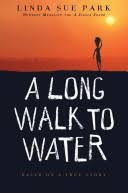
A Long Walk to Water
Linda Sue Park (2010)
“A true story of survival across two timelines: a boy walks 1,500 miles across a war-torn continent so that, decades later, a girl will not have to.”
This page prints on a single page. Use Ctrl+P / Cmd+P.
A Long Walk to Water
Linda Sue Park (2010) · 121pages · Contemporary
Summary
A Long Walk to Water tells two parallel true stories set in Sudan. In 1985, eleven-year-old Salva Dut flees the Second Sudanese Civil War and walks thousands of miles through desert and danger to a refugee camp. In 2008, eleven-year-old Nya walks eight hours every day to fetch water from a pond that makes her family sick. The timelines converge when Salva, now an adult leading a nonprofit called Water for Sudan, arrives in Nya's village to drill a well. They never meet on the page, but his survival made her life possible.
Why It Matters
A Long Walk to Water has sold over four million copies and is one of the most widely assigned middle school texts in the United States. It introduced millions of young readers to the Lost Boys of Sudan and to global water inequality. The novel functions simultaneously as literature and as advocac...
Themes & Motifs
Diction & Style
Register: Accessible and direct — short declarative sentences, no ornamental vocabulary, calibrated for middle school without being simplified
Narrator: Third-person limited, alternating between Salva and Nya. The narrator is close to each character's perception — we kn...
Figurative Language: Low
Historical Context
Second Sudanese Civil War (1983-2005) and contemporary South Sudan water crisis: The novel cannot be understood outside its historical context because it IS its historical context — it is the story of specific events (the civil war, the Lost Boys migration, the water crisis) fi...
Key Characters
Talking Points
- Why does Park tell two stories at once instead of telling Salva's story from beginning to end? What does the reader understand by the end that they could not have understood if Nya's chapters were removed?
- Uncle Jeong tells Salva to stop thinking about how far it is and think about one step. Has this advice ever worked for you? Is it always good advice, or are there situations where it would be the wrong strategy?
- Nya's character is a composite — she is not one real person but a representation of many girls who lived this experience. How does knowing this change your relationship to her story? Does it make her more or less real to you?
- Salva survives the desert, the Nile crossing, and years in refugee camps. He loses his uncle, his home, and his childhood. What quality does Park most want you to understand is the source of his survival — and is it something a person is born with, or something that can be learned?
- The water in the pond that keeps Nya's family alive is also the water that makes Akeer sick. How does Park use this fact to explain why the water crisis is so hard to solve without outside help?
Notable Quotes
“Salva did not stop running for a long time.”
“Nya had made this trip — or one just like it — nearly every day of her life.”
“He would have to be careful. He would have to watch and listen.”
Why Read This
Because it is the truest short novel you will ever read in school. Salva Dut is alive. The wells are real. The water is flowing in villages where it did not flow before. Reading this book is not abstract — it is your access point to a real person'...