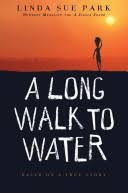
A Long Walk to Water
Linda Sue Park (2010)
“A true story of survival across two timelines: a boy walks 1,500 miles across a war-torn continent so that, decades later, a girl will not have to.”
A Long Walk to Water— Historical Context & Author Background
Author: Linda Sue Park · Published 2010· Era: Contemporary·121 pages
Themes explored: survival, hope, perseverance, water, community, war, education, connection
About Linda Sue Park
Linda Sue Park is a Korean American author born in Urbana, Illinois in 1960. She won the Newbery Medal in 2002 for A Single Shard. A Long Walk to Water (2010) grew from her research into Salva Dut's life and the work of Water for South Sudan (now the nonprofit's name). Park interviewed Salva Dut directly and worked with him to ensure the accuracy of his story. She has been a longtime supporter of his drilling projects. The book's proceeds have supported water well construction. Park has spoken about writing the book as a responsibility: she had access to Salva's story, and that access came with an obligation to share it accurately.
Life → Text Connections
How Linda Sue Park's real experiences shaped specific elements of A Long Walk to Water.
Park is the daughter of Korean immigrants who emphasized education as the path out of disadvantage
Salva's deep connection to schooling — he is at school when the war begins, pursues education throughout his refugee years, completes college in the US
Park understands education as both survival tool and identity. Salva's commitment to schooling is not incidental to his character — it is the mechanism of his survival.
Park has been transparent about interviewing Salva and fact-checking his account
The novel's author's note explains which events are documented, which are Park's reconstructions, and how Salva reviewed the manuscript
The collaboration model — survivor's testimony shaped into accessible narrative by a skilled author — has ethical implications. Park's transparency about the process is part of the book's argument about whose stories get told and how.
Historical Era
Second Sudanese Civil War (1983-2005) and contemporary South Sudan water crisis
How the Era Shapes the Book
The novel cannot be understood outside its historical context because it IS its historical context — it is the story of specific events (the civil war, the Lost Boys migration, the water crisis) filtered through the experience of specific people. Park does not ask the reader to imagine a fictional war. She asks them to understand a real one through the eyes of one child. The 2008 timeline grounds the historical narrative in a contemporary crisis that the reader can act on — Water for South Sudan is still active, still drilling wells.
Why A Long Walk to Water Matters Historically
A Long Walk to Water has sold over four million copies and is one of the most widely assigned middle school texts in the United States. It introduced millions of young readers to the Lost Boys of Sudan and to global water inequality. The novel functions simultaneously as literature and as advocacy — Park and Salva Dut have used its platform to raise funds for Water for South Sudan's drilling projects. It is a rare case of a middle grade novel that has had quantifiable real-world impact.
- One of the first young adult novels to use the dual-timeline structure to connect historical events to contemporary crises in the same geography
- Among the earliest widely-assigned texts to center an African child's perspective in an American classroom without a Western mediating character
- Pioneered the author-survivor collaboration model in middle grade nonfiction-adjacent fiction
Occasionally challenged for depictions of violence (the war scenes, Jeong's murder, the Nile crossing deaths) and for content some parents consider too emotionally intense for the assigned grade level. These challenges have not succeeded in removing the book from most curricula.