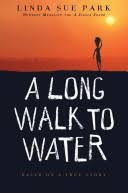
A Long Walk to Water
Linda Sue Park (2010)
“A true story of survival across two timelines: a boy walks 1,500 miles across a war-torn continent so that, decades later, a girl will not have to.”
Essay Questions & Food for Thought
30questions designed to challenge assumptions and provoke original thinking. These can't be answered from a summary — you need the actual text.
Why does Park tell two stories at once instead of telling Salva's story from beginning to end? What does the reader understand by the end that they could not have understood if Nya's chapters were removed?
Uncle Jeong tells Salva to stop thinking about how far it is and think about one step. Has this advice ever worked for you? Is it always good advice, or are there situations where it would be the wrong strategy?
Nya's character is a composite — she is not one real person but a representation of many girls who lived this experience. How does knowing this change your relationship to her story? Does it make her more or less real to you?
Salva survives the desert, the Nile crossing, and years in refugee camps. He loses his uncle, his home, and his childhood. What quality does Park most want you to understand is the source of his survival — and is it something a person is born with, or something that can be learned?
The water in the pond that keeps Nya's family alive is also the water that makes Akeer sick. How does Park use this fact to explain why the water crisis is so hard to solve without outside help?
Park describes Salva's time in the Kakuma refugee camp in a few pages even though he lived there for nine years. Why do you think she compresses this part of the story? What does the compression tell you about how Salva experienced those years?
At the end of the novel, Salva is revealed to be Dinka and Nya's people are Nuer. These two groups have been in conflict for generations. Why does Park make this the last thing the reader learns? How does it change the meaning of the well?
Park chose to write Nya as a fictional composite rather than a real named individual. What are the ethical risks of inventing a character to represent real people's experiences? What would be lost if Park had simply written about Salva alone?
The Second Sudanese Civil War killed two million people and displaced four million. The novel contains almost no political explanation of why the war happened. Is this a limitation of the book, or a deliberate choice? What does it mean to tell a war story without explaining the war?
Salva's father is sick from waterborne disease when Salva finds him. Park uses this detail to connect Salva's personal survival to his future work. Is this too convenient — does it feel like a plot device — or does it feel true? Explain your reasoning.
The novel ends with the well working and clean water flowing. But Park does not show us Salva and Nya actually meeting or speaking. Why might she have made this choice? What would be added — and what would be lost — if she had written the meeting?
Water appears in every chapter of this novel — as thirst, as obstacle (the Nile), as illness-source (the pond), and finally as gift (the well). Trace water through the novel's imagery. Is water consistently symbolic, or does its meaning change?
Park writes that Salva 'took' on a leadership role in the refugee camp. He did not seek it. He did not choose it. What does the novel suggest about how leaders emerge in crisis situations? Is leadership a personality trait or a response to circumstances?
The book's title is A Long Walk to Water, not A Long Run or A Long Journey. What does the specific choice of 'walk' communicate about the nature of both Salva's and Nya's experiences?
Park includes a detailed author's note explaining what is historically documented, what she reconstructed, and how Salva reviewed the manuscript. Why is this transparency important? What would change if Park had presented the novel as pure fiction without the note?
Buksa finds water in a tree root by reading signs in the environment. This traditional ecological knowledge saved lives during the Lost Boys migration. What does it mean that this knowledge exists and was nearly lost? What kinds of knowledge does our world undervalue?
The novel covers roughly twenty-three years of Salva's life in 121 pages. Calculate roughly how many pages per year that gives Park to tell his story. What must she leave out? What does compression do to a life story?
Salva lives in Rochester, New York for years and attends college. Park gives this period relatively little space. Does the American section feel like part of the same story, or like a different story? Why might an American reader find this section easier or harder to connect with?
Jeong is killed by bandits who are also fleeing the war. His killers are not soldiers or government officials but desperate people in the same situation. What does this complicate about the novel's portrait of conflict? Are the bandits villains?
The novel was published in 2010. South Sudan became an independent nation in 2011. A second civil war began there in 2013. Water for South Sudan continues to operate today. How does the existence of ongoing conflict after the novel's hopeful ending complicate your reading of it?
Park gives Nya no last name. Salva's full name, Salva Dut Ariik, is given and the reader knows he is a real person. What is the effect of this asymmetry? Why might Park have made different choices for the two protagonists' identities?
Every chapter in Nya's timeline ends without resolution — the walk continues, the water is still contaminated, Akeer is still sick. Every chapter in Salva's timeline ends in motion — he has survived this danger and is walking toward the next one. How does Park use chapter endings to create the dual tension of the novel?
The novel is sometimes described as a book about hope. Is it? Or is it a book about work? What is the difference between a story that says things will get better and a story that shows a specific person doing the specific things that made them better?
Salva's school education — interrupted by war, resumed in the refugee camp, completed in the United States — is a thread through the novel. What does the novel argue about the relationship between education and survival? Is education a luxury or a necessity in Salva's world?
The United Nations High Commissioner for Refugees (UNHCR) managed the Kakuma and Itang camps where Salva lived. Park does not describe the UN as heroic. What portrait does the novel paint of international humanitarian institutions — effective, insufficient, or something else?
Compare A Long Walk to Water to another novel you have read in which a young person survives extraordinary circumstances. What survival strategies does the protagonist of the other novel use? Does Park's novel suggest that Salva's strategy — one step at a time — is universal?
Park has said that the novel is as much Nya's story as Salva's, even though Nya has fewer pages and less backstory. Do you agree? Does the novel treat its two protagonists equally, or does it privilege one over the other?
The final line of the novel identifies Salva's tribal affiliation. If Park had placed this information at the beginning — if the reader had known from page one that Salva was Dinka — how would the reading experience be different?
Water for South Sudan has drilled hundreds of wells since Salva founded it. Each well serves hundreds of people and lasts for decades. Calculate the approximate number of person-years of clean water access that one well provides. Does doing this math change how you think about the novel's ending?
A Long Walk to Water is read by millions of American students each year in schools. What is the responsibility of an American student reading this book? Is reading enough? What does Park seem to believe the reader should do after finishing?