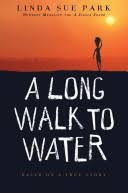
A Long Walk to Water
Linda Sue Park (2010)
“A true story of survival across two timelines: a boy walks 1,500 miles across a war-torn continent so that, decades later, a girl will not have to.”
Language Register
Accessible and direct — short declarative sentences, no ornamental vocabulary, calibrated for middle school without being simplified
Syntax Profile
Short, declarative sentences dominate. Park averages under fifteen words per sentence. Action sequences use three-to-five word sentences. Reflection uses slightly longer constructions. Dialogue is sparse and functional — characters communicate necessity, not personality. The lean syntax is a pedagogical choice: urgency and clarity over aesthetic complexity.
Figurative Language
Low — Park almost never uses extended metaphor or simile. Her language is purposefully transparent. The rare metaphors land harder precisely because of the surrounding plainness. Water functions symbolically across the novel but Park never labels it as such — the reader makes the connection from accumulated fact.
Era-Specific Language
The roughly 20,000 Sudanese boys who walked hundreds of miles to refugee camps during the Second Civil War
Unimproved natural water source — a muddy pond shared by humans and animals
Plastic container used for water transport across the developing world
UN-administered settlement for displaced persons — Kakuma and Itang in this novel
Mechanical device for boring wells deep into the earth — the solution to Nya's water crisis
How Characters Speak — Class & Identity
Salva Dut
No distinctive verbal register — Park writes his interiority in her own plain prose rather than through distinctive dialect
A choice not to exoticize Salva's voice. He thinks in universally legible terms — fear, memory, determination — making him accessible across cultures.
Nya
Minimal dialogue. Her interiority is rendered through action and observation rather than speech
Nya's silence is not shyness — it is the communicated experience of a child whose world is organized around labor rather than language.
Uncle Jeong
Direct, instructional, unadorned: 'Do not think about how far it is. Think about one step.'
Practical wisdom transmitted through practical language. Jeong's authority comes from knowledge, not position.
Narrator's Voice
Third-person limited, alternating between Salva and Nya. The narrator is close to each character's perception — we know what they know, feel what they feel — but Park never loses control of the structure by giving either character information the other does not have. The two voices are stylistically indistinguishable, which reinforces the thematic argument: these children's experiences are different in detail but identical in structure.
Tone Progression
Chapters 1-3
Urgent and disorienting
Salva's world collapses; Nya's world is established as constrained. The reader is placed in both children's uncertainty.
Chapters 4-6
Enduring and methodical
Survival becomes routine. The prose finds a rhythm that mirrors the walking — relentless, forward, one step at a time.
Chapters 7-8
Grief, then convergence
Loss, resilience, and finally the quiet triumph of two lives that never directly intersect but were always part of the same story.
Stylistic Comparisons
- Ishmael Beah's A Long Way Gone — another first-person account of child displacement in African conflict, but darker and less redemptive
- Bao Ninh's The Sorrow of War — war memoir from the other side of the world but with similar compression of horror
- Marjane Satrapi's Persepolis — another child's-eye account of political upheaval, different form (graphic memoir) but similar emotional structure
Key Vocabulary from This Book
Notable words used in this text — click to see full definitions