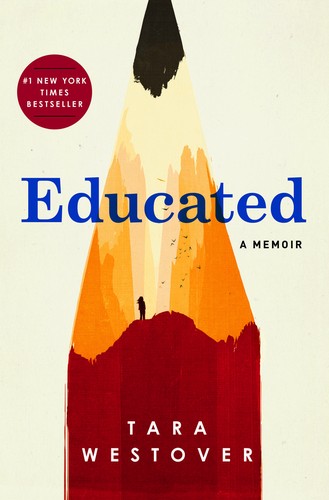
Educated
Tara Westover (2018)
“A woman who never set foot in a classroom until age seventeen earns a PhD from Cambridge — and must decide whether knowledge is worth the family it costs her.”
Educated— Historical Context & Author Background
Author: Tara Westover · Published 2018· Era: Contemporary·334 pages
Themes explored: education, family, identity, abuse, faith, self-invention, memory, resilience
About Tara Westover
Tara Westover was born in 1986 in Clifton, Idaho, the seventh child of Val (Gene) and LaRee Westover. She had no birth certificate until age nine. She never attended school. She taught herself enough mathematics and grammar to pass the ACT at seventeen, entered Brigham Young University, won a Gates Cambridge Scholarship, and earned her PhD in intellectual history from the University of Cambridge in 2014. She began writing Educated shortly after completing her doctorate. It was published in 2018, spent over 200 weeks on the New York Times bestseller list, and won the Carnegie Medal for Excellence in Nonfiction. Her family disputes many of her accounts. Her parents and most of her siblings are estranged from her.
Life → Text Connections
How Tara Westover's real experiences shaped specific elements of Educated.
Westover has no formal schooling record until her BYU admission
The memoir's first half — no teachers, no classrooms, no institutional markers of childhood
The absence of institutional records means the family's version of events is, officially, the only version. Westover's memoir is partly an act of creating a record that didn't exist.
Westover's PhD is in intellectual history — the history of how ideas form and spread
The memoir's central argument about epistemology — who decides what is true, by what authority, and at what cost
Her academic specialty is literally the study of how knowledge is constructed. She is doing historiography on her own life.
Multiple family members publicly dispute her account; her parents have given interviews calling her accounts false
The memoir's explicit acknowledgment that her memories conflict with those of her family
The dispute is not just context — it is the memoir's argument enacted in real life. The book predicted its own reception.
Westover has said she struggled with whether to publish, knowing the cost to her family relationships
The memoir does not celebrate estrangement — it grieves it while refusing to recant
The emotional ambivalence of the ending is autobiographical. She is not glad this happened to her. She is only unwilling to pretend it didn't.
Historical Era
1980s–2010s rural Idaho; American survivalism and fundamentalist religious subcultures
How the Era Shapes the Book
Ruby Ridge happened just miles from the Westover property and is explicitly referenced. Gene's anti-government beliefs were not eccentric in isolation — they were the intensified version of a genuine movement that produced real events, real violence, and real adherents. Understanding this prevents the reader from treating Gene as simply one aberrant man, which is one of the memoir's more uncomfortable achievements.
Why Educated Matters Historically
Spent 200+ weeks on the New York Times bestseller list — the longest run of any book since the list changed its methodology. Won the Carnegie Medal for Nonfiction (2020). Translated into 45+ languages. Made Westover the rare memoirist whose first book becomes a cultural event rather than a personal statement. Prompted widespread discussion about homeschooling regulation, religious freedom versus child welfare, and the limits of memoir as truth-telling.
- One of the first memoirs to build the epistemological problem of memory into the book's formal structure — the conflicting accounts are not buried in an author's note but threaded through every chapter
- Brought survivalist/fundamentalist American subcultures into mainstream literary conversation without condescension or exoticization
- A PhD-dissertation-quality intellectual framework applied to personal narrative — historiography of a single life
Challenged in some conservative school districts for its depiction of religious extremism and family dysfunction, and for language describing abuse. Also challenged for undermining parental rights in homeschooling contexts — which, again, rather proves the memoir's argument.