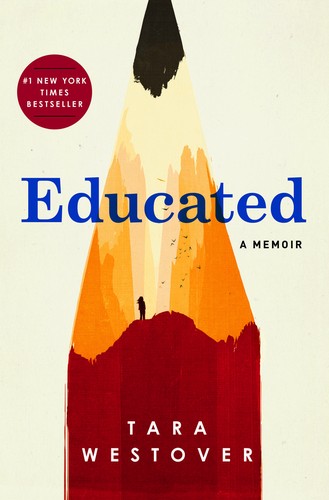
Educated
Tara Westover (2018)
“A woman who never set foot in a classroom until age seventeen earns a PhD from Cambridge — and must decide whether knowledge is worth the family it costs her.”
Language Register
Plain and declarative in childhood sections; expands to academic register as Westover's education progresses — the prose performs the memoir's subject
Syntax Profile
The memoir's most distinctive feature is the shift in sentence structure tracking the narrator's education. Part One: short declarative sentences, simple conjunctions, minimal subordination — the grammar of a child. Part Three: complex periodic sentences, embedded clauses, academic hedges — the grammar of a Cambridge historian. The transition is gradual and visible, making the prose itself a Bildungsroman.
Figurative Language
Moderate — Westover uses figurative language sparingly, which gives her metaphors disproportionate weight when they arrive. The mountain is the dominant figure: Buck's Peak appears throughout as presence, witness, and limit. Other figures are grounded and physical rather than decorative.
Era-Specific Language
Anti-government, self-sufficiency extremism — late 20th century American political fringe
Conspiracy theory target representing shadowy elite control — Gene's shorthand for institutional power
Mormon ritual of faith healing through laying on of hands — central to the family's medical avoidance
The study of how history is written — Westover's academic specialty, introduced with genuine shock
Shawn's baby-talk corruption of 'little sister' — functions as a mechanism of control and regression
How Characters Speak — Class & Identity
Gene Westover (Dad)
Biblical cadence, prophetic declaration, avoidance of institutional vocabulary. Says 'the Lord has shown me' where another man might say 'I think.'
Authority claimed through divine legitimation. His language puts him outside the systems that might question him.
LaRee Westover (Mother)
Shifts from practical, domestic speech in Part One to the language of an herbalism entrepreneur by Part Two — business vocabulary grafted onto faith vocabulary.
A woman finding agency in the only idioms available to her. Her evolution in language mirrors her evolution in power within the family — and her complicity.
Shawn
Affectionate diminutives when controlling, explosive profanity and misogynist slurs when violent. Baby talk ('Siddle Lister') as a weapon.
Language as domination: the same mouth that diminutizes is the mouth that degrades. The contrast between registers is itself the abuse pattern.
Tara (child narrator)
Plain, declarative, acceptance-coded. Describes violent events with the same syntactic flatness as describes daily work. No category difference between 'we hauled scrap' and 'he twisted my arm.'
The internalization of a world where these things are equally normal. Normalization visible in grammar.
Tara (adult narrator)
Academic, qualified, hedged — but capable of sudden declarative simplicity at emotional peaks. The simplest sentences carry the most weight.
Education has given her frameworks but not emotional distance. The adult narrator's clarity costs something; the simple sentences are where the cost shows.
Narrator's Voice
Dual narrator: a child's perceptual voice layered beneath an adult's analytical consciousness. The child narrator perceives without the categories to understand; the adult narrator provides the categories without overriding the original perception. The gap between them — visible, held open deliberately — is the memoir's formal argument about how memory and truth work.
Tone Progression
Part One (childhood)
Matter-of-fact, occasionally lyrical about landscape, flat about violence
The child's acceptance of her world as simply how things are. The prose doesn't signal that something is wrong because the narrator doesn't yet know.
Part Two (BYU/Cambridge)
Curious, then ashamed, then exhilarated, then grieving
The discovery of the gap between her upbringing and the world. Tone oscillates rapidly as education destabilizes every certainty.
Part Three (estrangement)
Clear, controlled, sorrowful, resolved
The prose of someone who has done the work of understanding and arrived at grief rather than rage. Not triumphant. Exact.
Stylistic Comparisons
- Mary Karr (The Liar's Club) — dysfunctional family memoir, but Karr's voice is more sardonic and self-consciously literary
- Frank McCourt (Angela's Ashes) — poverty and survival memoir, but less epistemological self-consciousness
- Maggie Nelson (The Argonauts) — memoir that integrates theoretical apparatus, closer in intellectual ambition if not subject matter
- Ta-Nehisi Coates (Between the World and Me) — memoir as meditation on systemic forces shaping individual consciousness
Key Vocabulary from This Book
Notable words used in this text — click to see full definitions