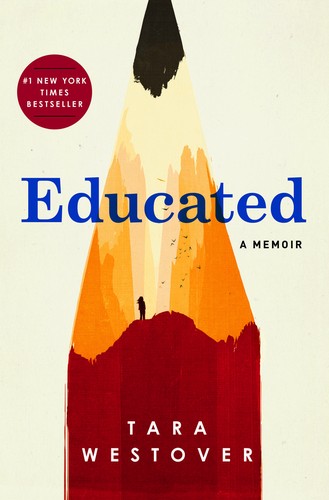
Educated
Tara Westover (2018)
“A woman who never set foot in a classroom until age seventeen earns a PhD from Cambridge — and must decide whether knowledge is worth the family it costs her.”
Essay Questions & Food for Thought
30questions designed to challenge assumptions and provoke original thinking. These can't be answered from a summary — you need the actual text.
Westover openly tells us that her memories conflict with her journals and with her family's accounts. Why does she include these contradictions rather than choosing one version? What is she arguing about the nature of memoir — and of memory itself?
The memoir's prose style changes measurably as Tara's education progresses — simpler, shorter sentences in childhood; longer, more qualified sentences by Cambridge. Is this a deliberate formal choice? What would be lost if she'd written the whole memoir in one consistent style?
Shawn calls Tara 'Siddle Lister' — a baby-name for 'little sister.' Why does Westover return to this detail repeatedly, and what does it tell you about how language can function as a tool of control?
Westover says she would not give back her education, but she does not say it was worth the cost. What is the difference between those two statements? Which is more honest?
Gene Westover's anti-government beliefs are connected to real events in Idaho: Ruby Ridge, the militia movement, Y2K. Does knowing this historical context make him more sympathetic, more dangerous, or neither? Does the memoir invite us to understand him or to judge him?
Tara does not have the word 'abuse' for what Shawn does to her until she is an adult. How does acquiring the word change what happened? Can naming something retroactively change the event itself?
Westover's mother initially appears to believe her about Shawn — then recants. Westover gives her mother's psychology genuine consideration rather than simply calling her a coward. What does she suggest is actually happening? Do you find it convincing?
The memoir describes Tara encountering the Holocaust for the first time by looking it up in a dictionary in her dorm room. What does this scene reveal about what she had been denied — and about the relationship between gaps in knowledge and gaps in framework?
Westover attended three elite universities and ended with a Cambridge PhD, but she says education is not the moral of her story. What is? What does she want readers to take from the memoir that 'go to school and you can succeed' doesn't capture?
Compare Gene Westover's authority over the family's reality to a social media algorithm's authority over what information users receive. In what ways is information control the same whether it happens in an Idaho compound or on your phone?
Westover never directly states that her father has a mental illness, though she provides extensive evidence a reader could use to make that diagnosis. Why might she withhold that label? What would be lost by including it?
The memoir describes serious, repeated injuries — burns, lacerations, car accidents — treated without medical care. Westover describes these with the same factual tone as the junkyard work. What is the effect of this tonal flatness? What would change if she'd written these scenes with more explicit horror?
Tyler Westover is the sibling who escapes first and who eventually believes Tara. Why does Westover make him so important to the memoir's resolution? What does his belief mean that academic success or therapeutic recognition does not?
Westover is writing a memoir about events her family publicly disputes, and she knows this. How does the acknowledgment of the dispute within the text change the memoir's ethical status? Is she doing something dishonest by publishing an account others deny, or something braver?
The memoir was published after Westover earned her PhD in intellectual history — the history of ideas. How does her academic training shape the way she tells her own story? Would the book be different if she had studied literature, or psychology, or nothing?
Westover describes herself as having loved Shawn — genuinely, not only out of compulsion or fear. How does this complicate the memoir's account of his abuse? Is it possible to love someone who hurts you? What does the memoir suggest?
The mountain — Buck's Peak — appears throughout the memoir as a near-living presence. What does the landscape mean, and why does Westover close the memoir with it?
Educated has been used to argue for stricter homeschooling regulation. Is that a legitimate use of the memoir? Does Westover intend it as a policy argument, or is that a misreading of what she's actually doing?
Many memoirists change names to protect privacy. Westover uses real first names for most family members. What is the ethical weight of that choice when the people named dispute her account?
Westover encounters her first history class and is shocked to find that events she was told never happened — the Holocaust, the civil rights movement — not only happened but are extensively documented. What does this reveal about her father's method of control? Was he lying, or does he believe his own history?
Compare Tara's self-invention to Jay Gatsby's in The Great Gatsby. Both reinvent themselves entirely, both pay an enormous cost, both are driven by a dream of becoming someone different. What is fundamentally different about their projects?
Westover attends BYU as a believing Mormon — the same faith that underpins her father's extremism. How does she maintain faith in the institution while rejecting her father's version of it? Is this coherent, or does the memoir expose a tension she never fully resolves?
The memoir describes multiple near-death experiences involving the family — the car accident, the burns, the gas explosion — each survived through what Gene calls faith. Westover does not tell us whether she believes these were miracles. Why?
Westover earned her Cambridge PhD in intellectual history — specifically, she studied the idea of Jewish emancipation in 19th-century European thought. Why might that particular subject matter — exclusion, access to institutions, the politics of who is allowed to participate in public life — resonate with her own experience?
A reader could argue that Educated is an indictment of American religious freedom — that the legal protections allowing families like the Westovers to refuse school, doctors, and birth certificates enabled serious harm. Does the memoir support this reading? Does Westover?
The memoir's most discussed formal feature is the use of conflicting accounts — moments where Westover notes that her journal, her memory, and her family's account disagree. Choose one such moment and analyze what each version reveals about who needs the story to be which way.
Westover's memoir has been criticized for being too generous to her parents — for giving them too much psychological complexity when a simpler condemnation would be more useful for survivors of similar situations. Do you agree? Is complexity a form of fairness, or a form of excuse?
By the memoir's end, Westover has her education and has lost her family. She describes this as a choice but also as something done to her. Is it both? Who made the final choice that broke the family's connection?
Westover rarely describes physical sensations in the memoir — pain, cold, hunger, fear are noted but not dwelt on. The emotional reality is rendered precisely but the bodily experience is kept at a distance. What might explain this restraint? What would the memoir become if she leaned into the bodily experience of what happened to her?
The memoir ends without resolution — no reconciliation, no catharsis, no final confrontation. Westover simply has a self, and her family is elsewhere. Is this a satisfying ending? What would be wrong with a more dramatic conclusion?