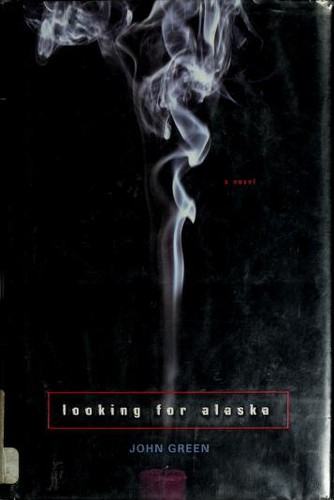
Looking for Alaska
John Green (2005)
“A boy obsessed with famous last words falls in love with a girl who is looking for the way out of the labyrinth — and doesn't survive to find it.”
Language Register
Conversational with bursts of genuine literary intensity — teenage voice that earns its philosophical reach
Syntax Profile
Miles's narration uses short-to-medium declarative sentences that occasionally break into longer, more rhythmically complex units when emotion overwhelms his default economy. Alaska's dialogue is volatile — she pivots mid-sentence, italicizes words for emphasis, and uses profanity structurally rather than casually. The Colonel speaks in declaratives, often starting sentences with 'Because' — a habit that signals his particular mode of reasoning: effect first, cause second.
Figurative Language
Moderate — concentrated at emotional peaks. Green's metaphors tend to arrive once and land hard rather than threading through chapters. The labyrinth and the Great Perhaps are the dominant recurring figures; otherwise Green trusts plain language to carry emotional weight.
Era-Specific Language
Wealthy day students who go home on weekends — the boarding school's entitled class
Culver Creek cafeteria food; the word functions as shorthand for institutional grimness
Culver Creek boarding school; synecdoche for the bounded world of the novel
Drawn from Bolívar's last words; becomes the novel's central metaphor for the inescapability of suffering
From Rabelais's alleged last words; Miles's name for whatever lies beyond his Florida suburb
How Characters Speak — Class & Identity
Miles Halter (Pudge)
Precise, self-deprecating, given to long subordinate clauses when processing emotion. His literary references are genuine rather than performed — he actually thinks in Rabelais and García Márquez.
Middle-class Florida kid who has read more than he has lived. The gap between his vocabulary and his experience is the novel's comic engine in the early chapters and its tragic engine later.
Alaska Young
Volatile syntax, sudden italics, ability to shift from profanity to quotation within a single sentence. Her speech has a quality of controlled chaos that suggests she is always slightly ahead of whatever she's saying.
A mind moving faster than language can keep up. The speed is partly brilliance and partly a way of not finishing sentences about things that hurt.
Chip 'the Colonel' Martin
Blunt, declarative, working-class Alabama. He doesn't use metaphor when a fact will do. His loyalty is expressed through action rather than language.
A scholarship kid at a rich-kid school who has decided not to perform the school's register. His directness is a form of dignity.
Takumi Hikohito
Observational, slightly ironic, less emotionally invested in the central drama than Miles but more perceptive because of it. The odd-man-out clarity.
The novel's secondary conscience — he sees things clearly precisely because he's not in love with Alaska.
Narrator's Voice
Miles Halter: a teenager who is smarter than he is experienced, more perceptive than he is wise, and deeply earnest beneath the self-deprecation. His voice is reliable about facts and unreliable about his own emotional states — he consistently underestimates how deeply things affect him until they've already broken him. The gap between his observed intelligence and his emotional blindspots is where most of the novel's tragedy lives.
Tone Progression
Before (early)
Anxious, excited, yearning
Miles is trying everything for the first time. The prose has a nervous energy — he's watching himself participate in his own life.
Before (late)
Happy, charged, oblivious
Miles is in it now — in the friendship, in the crush, in the life he came to find. The prose relaxes into joy it doesn't know is temporary.
After (early)
Flat, shocked, procedural
The prose loses its color. Short sentences, factual register, grief that hasn't found its form yet.
After (late)
Purposeful, mournful, resolved
The investigation gives Miles something to do with his grief. The prose finds its footing again — not happy, but moving.
Stylistic Comparisons
- The Perks of Being a Wallflower — similar confessional teenage voice, but Chbosky's narrator is less literary and more wounded
- The Catcher in the Rye — both first-person teenage narrators using intelligence to resist the world's demands; Holden is more cynical, Miles more earnest
- A Fault in Our Stars (Green's own later novel) — shares the YA-meets-mortality DNA, but Alaska is darker and less redemptive in its ending
Key Vocabulary from This Book
Notable words used in this text — click to see full definitions