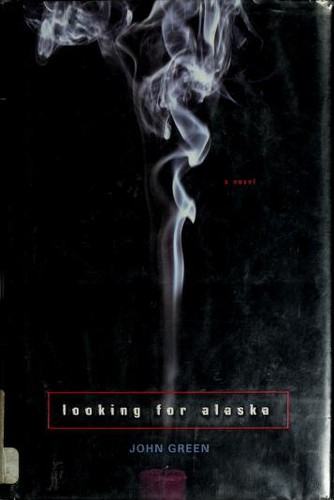
Looking for Alaska
John Green (2005)
“A boy obsessed with famous last words falls in love with a girl who is looking for the way out of the labyrinth — and doesn't survive to find it.”
Looking for Alaska— Summary & Analysis
by John Green · published 2005 · 221 pages · Contemporary
A user-friendly study guide for Looking for Alaska by John Green (2005): a high-level plot summary, full chapter-by-chapter analysis, theme breakdowns, character profiles, and 30 essay questions designed for middle-school, high-school readers. Unlike a stock summary, sumsumsum.com adds a diction analysis drawn from John Green’s actual text, the 2 documented AP Literature exam appearances of this book, and reading-difficulty guidance (Easy, 1/10) so students, teachers, and lifelong readers know what they are walking into.
“A boy obsessed with famous last words falls in love with a girl who is looking for the way out of the labyrinth — and doesn't survive to find it.”
Short Summary
Miles Halter, a lonely Florida teenager obsessed with famous last words, transfers to Culver Creek boarding school in Alabama, where he meets Alaska Young — beautiful, reckless, brilliant, and damaged. They fall in love before he can tell her. One night Alaska drives drunk into a police cruiser and dies. The second half of the novel is Miles and his friends trying to determine whether it was an accident or suicide, and whether meaning can be made from either answer.
Detailed Summary
Miles 'Pudge' Halter is sixteen, friendless, and obsessed with memorizing the last words of famous people. He transfers to Culver Creek Preparatory School in Alabama, drawn by the promise that the great poet François Rabelais spent his final moments planning 'the great perhaps.' Miles believes somet...
Summary in the Author’s Writing Style
A retelling of Looking for Alaska in John Green’s style — so you can hear the language, not just the plot. This is a stylistic pastiche written by sumsumsum, not an excerpt from the book.
I memorized the last words of dying men because they were the only people who had ever figured out what mattered, and because François Rabelais, who was a poet and a drunk, said he was leaving to seek a Great Perhaps. That was why I went. Sixteen years old, no friends, a boy who knew too many facts …
Chapter-by-Chapter Analysis
If you liked Looking for Alaska, read next
Start with A Monster Calls by Patrick Ness — Another YA treatment of grief that refuses sentimentality — Ness and Green both trust young readers to hold unresolved pain without being destroyed by it. Or pivot to The Secret History by Donna Tartt — A college novel also structured around a death that the reader knows is coming from the first page — both use dramatic irony as the engine of dread and meaning.
For comparative essays, pair Looking for Alaska with
The strongest comparative pairing is The Perks of Being a Wallflower (Stephen Chbosky) — Same confessional teenage voice navigating grief and outsider identity, but Chbosky's trauma is more internal and less philosophically framed. Another productive pairing is The Catcher in the Rye (J.D. Salinger) — First-person teenage narrator using intelligence as armor; Holden is more cynical and paralyzed where Miles is earnest and moving forward. For a third angle, contrast with Thirteen Reasons Why (Jay Asher) — Both deal with teenage death and its aftermath in a high school setting — Asher gives definitive answers where Green refuses to; the contrast is philosophically instructive.
Each of these pairings opens a clean thesis path on shared themes, period diction, or formal influence — useful for AP Lit / IB / first-year college comparative essays.
More from John Green and the scholars who study Green
Other works by John Green: The Fault in Our Stars (2012, 313 pages). Reading two or three of these in sequence reveals John Green’s recurring obsessions and stylistic signatures more clearly than any single book can.