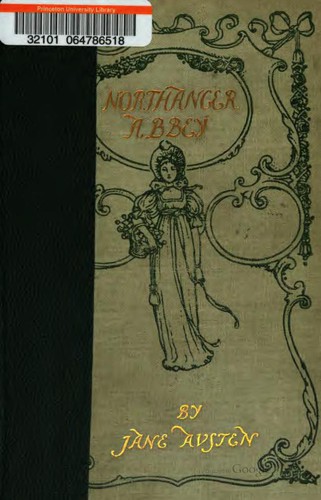
Northanger Abbey
Jane Austen (1817)
“A young woman raised on Gothic novels arrives at a real abbey and discovers that real life is far more dangerous — and far more ordinary — than fiction.”
Northanger Abbey— Summary & Analysis
by Jane Austen · published 1817 · 260 pages · Romantic / Regency
A user-friendly study guide for Northanger Abbey by Jane Austen (1817): a high-level plot summary, full chapter-by-chapter analysis, theme breakdowns, character profiles, and 30 essay questions designed for ap-english, college, ib readers. Unlike a stock summary, sumsumsum.com adds a diction analysis drawn from Jane Austen’s actual text, the 7 documented AP Literature exam appearances of this book, and reading-difficulty guidance (Easy, 2/10) so students, teachers, and lifelong readers know what they are walking into.
“A young woman raised on Gothic novels arrives at a real abbey and discovers that real life is far more dangerous — and far more ordinary — than fiction.”
Short Summary
Naive Catherine Morland, a clergyman's daughter who devours Gothic novels, visits Bath and befriends the charming but manipulative Thorpe siblings and the witty Tilneys. Invited to the ancient Northanger Abbey by the Tilneys, her Gothic-soaked imagination conjures murder plots and sinister secrets that do not exist. She is humiliated, corrected, and eventually educated by experience — and by the love of Henry Tilney. The novel is both a coming-of-age story and a pointed satire of the Gothic genre, the novel-reading panic of the 1790s, and the social machinery that shapes women's lives.
Detailed Summary
Catherine Morland is seventeen, the daughter of a country clergyman, and almost comically unsuited to be a Gothic heroine: plain, clumsy, more interested in cricket than needlework, and raised in a happy, unremarkable family. Austen's opening paragraph announces this deliberately — the heroine of th...
Summary in the Author’s Writing Style
A retelling of Northanger Abbey in Jane Austen’s style — so you can hear the language, not just the plot. This is a stylistic pastiche written by sumsumsum, not an excerpt from the book.
No one who had ever seen Catherine Morland in her infancy would have supposed her born to be a heroine. Her situation in life, the character of her father, a clergyman of unobjectionable temper, the plain good sense of her mother, who lived to bear ten children and was never once obliged to die of a…
Chapter-by-Chapter Analysis
If you liked Northanger Abbey, read next
Start with The Mysteries of Udolpho by Ann Radcliffe — The Gothic novel Northanger Abbey directly parodies — reading it alongside Austen makes every joke clearer and every satirical target visible. Then try Jane Eyre by Charlotte Bronte — Another novel set partly in a forbidding ancestral house with a secret — but Bronte plays the Gothic straight. The comparison illuminates what Austen refuses to do.. Or pivot to The Female Quixote by Charlotte Lennox — A 1752 novel about a woman whose reading of French romances distorts her perception of reality — the direct predecessor of Northanger Abbey's central joke.
For comparative essays, pair Northanger Abbey with
The strongest comparative pairing is Don Quixote (Miguel de Cervantes) — The original novel about a reader whose fiction-soaked imagination distorts his experience of reality — the ancestor of the entire tradition Austen is working in.
Each of these pairings opens a clean thesis path on shared themes, period diction, or formal influence — useful for AP Lit / IB / first-year college comparative essays.
More from Jane Austen and the scholars who study Austen
Other works by Jane Austen: Emma (1815, 474 pages), Mansfield Park (1814, 483 pages), Persuasion (1817, 249 pages), Pride and Prejudice (1813, 432 pages). Reading two or three of these in sequence reveals Jane Austen’s recurring obsessions and stylistic signatures more clearly than any single book can.
The standard scholarly entry points to Jane Austen’s work: Claudia L. Johnson (Princeton, Murray Professor of English) — Jane Austen: Women, Politics, and the Novel (1988); Mary Lascelles (Oxford, Somerville College) — Jane Austen and Her Art (1939); Lionel Trilling (Columbia, Trilling lectures on Austen) — The Opposing Self (1955). These are the works graduate seminars cite when teaching Jane Austen.