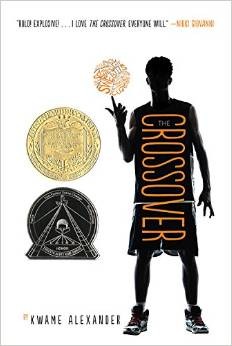
The Crossover
Kwame Alexander (2014)
“A novel written in slam-poetry verse about twin brothers, basketball, and the shot clock running out on childhood.”
The Crossover— Historical Context & Author Background
Author: Kwame Alexander · Published 2014· Era: Contemporary·237 pages
Themes explored: family, basketball, brotherhood, loss, growing-up, identity, language, health
About Kwame Alexander
Kwame Alexander (born 1968) grew up in a literary household — his mother was an English teacher, his father a publisher. He played basketball as a teenager and nearly pursued it seriously before choosing writing. He spent years as a poet, spoken word performer, and publisher before The Crossover became his breakthrough. Alexander has said the novel took him seven years to write and was rejected by multiple publishers who didn't believe a verse novel about basketball would find an audience. He has since become one of the most influential voices in children's literature, winning the Newbery Medal (2015), the Coretta Scott King Honor, and the Lee Bennett Hopkins Poetry Award. He has written over 35 books and is a vocal advocate for getting books into the hands of reluctant readers, particularly young Black boys.
Life → Text Connections
How Kwame Alexander's real experiences shaped specific elements of The Crossover.
Alexander played basketball as a teenager and considered pursuing it seriously before choosing writing
Josh's dual identity as athlete and poet — the verse form itself is the fusion of Alexander's two passions
The novel's central formal innovation (basketball rendered as poetry) is autobiographical. Alexander knows both worlds from the inside.
Alexander's father was a publisher who filled their home with books; his mother was an English teacher who insisted on reading
Crystal Bell's insistence that her sons read alongside playing basketball — the Bell household values both body and mind
The Bell family's intellectual-athletic balance is drawn from Alexander's own upbringing. The novel argues that these worlds are not separate.
The novel was rejected by multiple publishers who doubted a verse novel about basketball could succeed
The novel's own form — short, rhythmic, visually playful — was designed to reach readers who had given up on books
Alexander wrote against the publishing establishment's assumptions about who reads and how. The Crossover's success vindicated his belief that form can create access.
Alexander has spoken publicly about losing family members and the particular grief of watching a strong man's health fail
Chuck Bell's decline and death — the emotional specificity of watching a physically powerful father become fragile
The novel's grief is not abstract but drawn from personal loss. Alexander writes Chuck's death with the authority of someone who has sat in that hospital chair.
Historical Era
Contemporary America — 2010s, post-Obama era, ongoing conversations about race, masculinity, and representation in youth literature
How the Era Shapes the Book
The Crossover arrives at a moment when children's literature is actively reckoning with whose stories get told and in what forms. Alexander writes a novel that centers a loving, intact Black family — not in response to deficit narratives but as a corrective to them. Chuck and Crystal Bell are not defined by struggle or dysfunction but by warmth, humor, and the specific textures of Black family life. The verse form is itself a political choice: by writing in rhythms borrowed from hip-hop and spoken word, Alexander legitimizes a cultural tradition that literary gatekeepers had dismissed. The novel's health crisis subplot addresses a real public health emergency — Black men in America die from hypertension-related illness at dramatically higher rates — without reducing the characters to statistics.
Why The Crossover Matters Historically
Won the 2015 Newbery Medal — one of the few verse novels and one of the few sports-centered novels to receive the award. Demonstrated that poetry could be commercially successful in the middle-grade market and that reluctant readers would engage with literary experimentation if the form served the story. Sold over 2 million copies and spawned sequels (Booked, Rebound) and a graphic novel adaptation.
- One of the first verse novels to win the Newbery Medal, legitimizing the form for middle-grade literature
- Pioneered the use of concrete poetry, hip-hop rhythm, and visual experimentation in a mainstream children's novel
- One of the first widely successful sports novels to treat athletics as literary metaphor rather than genre entertainment
- Demonstrated that a novel centering a loving Black family could achieve massive crossover (pun intended) commercial success
Challenged in some school districts for 'mature themes' including death and grief, and occasionally for 'inappropriate language' — though the novel contains no profanity. The challenges are widely viewed as misguided given the novel's age-appropriate treatment of loss and its Newbery Medal status.