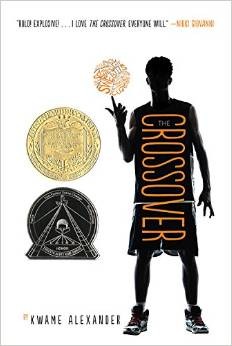
The Crossover
Kwame Alexander (2014)
“A novel written in slam-poetry verse about twin brothers, basketball, and the shot clock running out on childhood.”
Essay Questions & Food for Thought
30questions designed to challenge assumptions and provoke original thinking. These can't be answered from a summary — you need the actual text.
Why does Alexander choose to write The Crossover as a verse novel instead of prose? What can the verse form do that a traditional novel cannot, and what does it sacrifice?
Josh's nickname 'Filthy McNasty' comes from a Miles Davis album. Why does Alexander root Josh's identity in jazz rather than in contemporary hip-hop? What does this choice reveal about the Bell family?
The basketball rules Chuck teaches his sons work as sports advice and as life philosophy. Choose one rule and explain how its meaning shifts when applied to Chuck's refusal to see a doctor.
Josh throws a basketball at JB's face and breaks his nose. Is this moment out of character, or has Alexander been building toward it? Trace the emotional buildup through the preceding poems.
Crystal Bell says to Josh: 'You're not angry at your brother. You're afraid of losing him.' Is she right? How does this line reframe everything that has happened between the twins?
We see Miss Sweet Tea (Alexis) almost entirely through Josh's resentful perspective. What do we NOT know about her? Is Alexander's decision to keep her underdrawn a flaw or a deliberate choice?
How does the physical appearance of the poems on the page change across the four quarters of the novel? What is Alexander doing with white space, line length, and visual arrangement?
Chuck Bell refuses to see a doctor despite visible symptoms. Is his refusal a character flaw, a cultural commentary, or both? Consider the specific pressures on Black men regarding healthcare and vulnerability.
The title 'The Crossover' has at least three meanings. Identify all three and explain how Alexander layers them throughout the novel. Which meaning is most important by the final page?
Compare Josh's grief process in the final quarter to the stages of grief you may have studied (denial, anger, bargaining, depression, acceptance). Does Josh follow the model? Does Alexander even believe in stages?
Alexander uses concrete poetry — words shaped like basketballs, arranged in arcs, cascading down the page. Find three examples and explain what the visual shape adds to the poem's meaning.
The novel centers a loving, intact Black family — two parents, two children, a home full of laughter and basketball. Why is this representation significant in the context of American children's literature?
Josh's dreadlocks are described as his 'superpower.' Why does Alexander make hair so central to Josh's identity? What happens to Josh's sense of self when his identity markers are threatened?
How does Alexander handle the passage of time differently from a prose novel? What is the effect of having some poems cover entire weeks while others cover single seconds?
The Crossover won the Newbery Medal in 2015. Some critics argued that a verse novel and a sports novel shouldn't win literature's most prestigious children's book award. What assumptions about 'real literature' are embedded in that criticism?
Crystal Bell is the only character who uses medical language. Why does Alexander restrict clinical vocabulary to one character? What does it mean that the family's most educated member is also its most powerless in the face of Chuck's refusal?
Compare The Crossover to another verse novel you've read (Brown Girl Dreaming, Long Way Down, or The Poet X). How do different authors use the verse form for different purposes? Is the form more suited to some stories than others?
When Josh recites his father's basketball rules back to Chuck in the hospital, the gesture is simultaneously loving and futile. Why does Alexander include this scene? What does it say about the power and limits of language?
The novel ends with Josh back on the basketball court, dribbling, executing the crossover. Is this a hopeful ending, a sad ending, or something more complicated? What is Alexander's final argument about loss and continuation?
How would this novel be different if JB narrated instead of Josh? What would we see more of, and what would we lose?
Alexander has said The Crossover was rejected by publishers who didn't believe a verse novel about basketball could succeed. What assumptions about young readers — particularly young Black male readers — are embedded in those rejections?
Chuck's basketball rules stop appearing after his stroke. Why does Alexander remove them? What fills the space they leave behind?
Is The Crossover a tragedy? Apply the classical definition (a noble character brought down by a fatal flaw) to Chuck Bell. Does he qualify as a tragic hero?
The novel uses basketball as its central metaphor, but it's really about language — nicknames, rules, trash talk, poetry. How does Alexander argue that language and sports are connected? Do you agree?
Compare Josh Bell to Hamlet. Both are young men dealing with a father's death, a brother relationship under strain, and the pressure to act. Is this comparison productive or absurd?
Alexander uses capitalization as a literary device — words in ALL CAPS function like slam-poetry emphasis. Find five examples and explain what the capitalization adds that italics or bold could not.
How does The Crossover handle masculinity? Josh, JB, and Chuck all perform different versions of manhood. Which version does the novel endorse, if any?
If you removed every basketball reference from The Crossover, what story would remain? Could the novel work without sports, or is basketball essential to its structure and meaning?
The Crossover is often called 'the book that gets reluctant readers reading.' What specific formal and stylistic choices make it accessible to readers who typically resist books? Is 'accessible' the same as 'simple'?
Read the final poem of The Crossover aloud. How does the sound — the rhythm, the pace, the breath — create meaning that silent reading misses? What does this tell you about the relationship between poetry and performance?