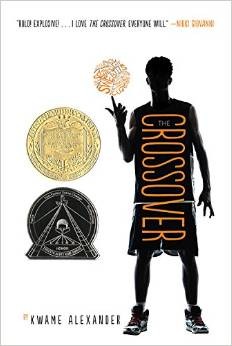
The Crossover
Kwame Alexander (2014)
“A novel written in slam-poetry verse about twin brothers, basketball, and the shot clock running out on childhood.”
Language Register
Informal and contemporary — rooted in African American vernacular, hip-hop cadence, and spoken word poetry, elevated by concrete poetry techniques and formal experimentation
Syntax Profile
Short, percussive lines averaging 3-8 words. No conventional paragraphs — every page is a poem. Enjambment drives momentum: lines break mid-phrase to create suspense and rhythm. Capitalization functions as volume control — LOUD WORDS slam like a dunk, quiet words whisper like a free throw. Concrete poetry shapes (words arranged as basketball arcs, spirals, descending patterns) make the page a visual court.
Figurative Language
High — but expressed through accessible metaphor rather than literary allusion. Basketball IS the figurative language: every game term doubles as emotional vocabulary (blocked, crossed over, fouled, out of bounds). Simile is rare; Alexander prefers metaphor that collapses the distance between vehicle and tenor (the court IS life, the ball IS heart).
Era-Specific Language
Basketball dribble move where the ball switches hands to misdirect a defender — also the novel's central metaphor for transition
Slang for exceptionally skilled, as in 'filthy crossover' — reclaimed as a term of excellence
Josh's locks are his identity marker and 'superpower' — tied to Black cultural expression and individuality
Playing basketball at a high level — also slang for living well, succeeding
Chuck Bell's basketball nickname — signals his legendary status and the masculine ideal Josh idolizes
How Characters Speak — Class & Identity
Josh Bell (Filthy McNasty)
Hip-hop inflected, rhythmic, heavy on slang and basketball terminology. Internal monologue is more poetic than his spoken dialogue — he's a writer who doesn't know it yet.
A twelve-year-old Black boy whose intelligence expresses itself through rhythm rather than formal diction. The verse form IS his voice — he thinks in beats.
JB (Jordan Bell)
Smoother, more socially calibrated. Less slang than Josh when around Alexis. Code-switches between basketball talk with Josh and gentler speech with Miss Sweet Tea.
JB is already learning to move between social worlds — a skill Josh hasn't developed. His linguistic flexibility signals emotional maturity.
Chuck Bell (Da Man)
Basketball rules delivered in aphoristic, almost biblical cadence. Casual conversation is warm, teasing, full of nicknames. Refuses the language of illness — no medical vocabulary enters his speech.
A man whose entire philosophy is built on competition and strength. His refusal to speak about illness IS his illness — he cannot name what he cannot fight on a court.
Crystal Bell
Precise, educated, direct. Uses full sentences where others use fragments. The only character who speaks in medical terms ('hypertension,' 'cholesterol'). No slang.
The family's intellectual anchor. Her language marks her as the one who sees clearly — and the one whose clarity is most painful, because she can name what's coming and cannot stop it.
Narrator's Voice
Josh Bell: present-tense, first-person, unreliably emotional. He reports what he sees and feels with the intensity and distortion of a twelve-year-old. His unreliability is not deceptive but developmental — he misreads situations not because he's dishonest but because he's young. The verse form amplifies his subjectivity: every poem is filtered through his heartbeat.
Tone Progression
First Quarter
Exuberant, confident, rhythmic
Pure basketball joy. The verse bounces. Josh is on top of the world and his language shows it — loud, fast, full of swagger.
Second Quarter
Angry, fractured, isolated
Jealousy and violence. The poems shorten, harden, lose their music. White space increases as Josh's world contracts.
Third Quarter
Hopeful but shadowed, bittersweet
Reconciliation and championship energy layered over growing dread. The rhythm returns but carries a minor key.
Fourth Quarter
Devastated, sparse, ultimately resilient
Grief strips the verse to its bones. Silence dominates. The final poems rebuild slowly — not to joy but to continuation.
Stylistic Comparisons
- Jacqueline Woodson's Brown Girl Dreaming — verse memoir with similar rhythmic intimacy, but Woodson's register is quieter and more reflective
- Jason Reynolds's Long Way Down — another verse novel about a young Black boy in crisis, but darker and more urban
- Walter Dean Myers's Monster — mixed-form YA that also centers a young Black male voice, but uses screenplay format rather than verse
- Nikki Giovanni's poetry — the hip-hop-inflected lyricism and unapologetic Blackness that Alexander inherits and extends
Key Vocabulary from This Book
Notable words used in this text — click to see full definitions