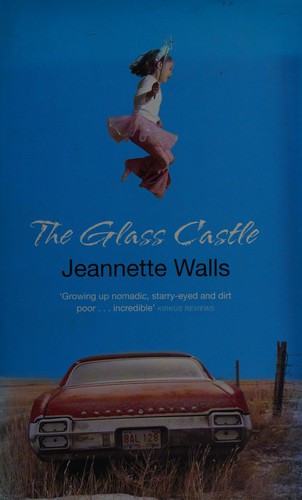
The Glass Castle
Jeannette Walls (2005)
“A woman watches her parents dumpster-dive from a Manhattan taxi and realizes she has spent her whole life ashamed of the people who made her.”
Language Register
Conversational and precise — Anglo-Saxon vocabulary, short declarative sentences, almost no metaphor. Walls writes like a journalist who has decided to tell the truth about herself.
Syntax Profile
Short declarative sentences dominate. Walls averages 12-15 words per sentence — unusually compressed for literary memoir. She uses 'and' as a connector rather than subordinating conjunctions, giving the prose a child's matter-of-fact rhythm even in adult retrospection. Lists appear frequently — inventories of what the family has, or doesn't have, or is leaving behind.
Figurative Language
Very low — this is one of the most figuratively spare literary memoirs of its era. Walls virtually never uses metaphor or simile. When figurative language appears, it lands with disproportionate force precisely because of its rarity.
Era-Specific Language
The family's term for their midnight escapes from creditors and authorities — normalizing flight as routine
Jeannette's childhood term for her father's excavation of the glass castle foundation — affectionate, hopeful
Rose Mary's preferred term over 'homeless' — her refusal of the label is itself a character study
Rex's term for fears — he names his children's fears so they can confront them; Hot Pot is his treatment
Rex's romantic mythology of self-reliance and frontier independence — part genuine value, part excuse
How Characters Speak — Class & Identity
Rex Walls
Alternates between technical precision (engineering, physics, geology vocabulary) and barroom bluster. Sober Rex speaks in complete, intelligent sentences. Drunk Rex is loose, maudlin, and grandiose.
Rex is genuinely educated and genuinely alcoholic — his intelligence makes his failures more painful, not less.
Rose Mary Walls
Educated diction with deliberate anti-materialist vocabulary. Refuses words like 'poverty' and 'hungry' — replaces them with 'simplicity' and 'hungry in spirit.' Her language performs a philosophy.
Rose Mary's vocabulary is a defense against reality. She controls what something means by controlling what it's called.
Jeannette (child)
Matter-of-fact, physical, problem-solving. No complaints, no self-pity. Describes dangerous situations the way a carpenter describes a loose board — something to be fixed.
The coping strategy of a child who has learned that feelings are less useful than solutions.
Jeannette (adult narrator)
Journalistic restraint — precise, selective, affectively controlled. The narrator's discipline is itself the story of what she built from the Walls childhood.
The adult Jeannette has taken her father's raw intelligence and her own survival instinct and forged them into craft. The style IS the escape.
Narrator's Voice
Jeannette Walls: retrospective, restrained, neither self-pitying nor self-congratulatory. She is the most controlled narrator of a chaotic childhood in recent American memoir. Her refusal to perform outrage is itself the book's central argument: these things happened, I survived them, I loved the people responsible. All three of those sentences are true simultaneously.
Tone Progression
Prologue and Part One
Confessional, provisional
Walls establishes the frame of shame and its examination. The tone is wary — she is taking a risk by writing this and she knows it.
Part Two: The Desert
Adventurous, warm, retrospectively clear-eyed
The desert childhood is rendered with genuine love and genuine unease. The warmth is not false — it's what she actually felt.
Part Three: Welch
Bleak, determined, quietly furious
The prose cools as the temperature drops. The outrage that never appears in narration accumulates in the facts reported.
Part Four: New York
Complex, guilty, bittersweet
Escape produces grief as well as relief. The success is real; the cost is real.
Epilogue
Warm, unresolved, honest
The ending earns its warmth by refusing to falsify the difficulty that precedes it.
Stylistic Comparisons
- Frank McCourt's Angela's Ashes — similar Irish-American poverty memoir, but McCourt is funnier and more performatively sad where Walls is more restrained
- Mary Karr's The Liar's Club — similar chaotic childhood, difficult parents; Karr is more literary and more wounded
- Rick Bragg's All Over But the Shoutin' — Appalachian poverty and a complicated parent; closer in geography and class, different in gender dynamics
Key Vocabulary from This Book
Notable words used in this text — click to see full definitions