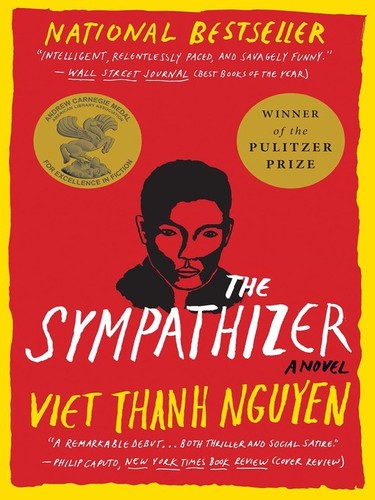
The Sympathizer
Viet Thanh Nguyen (2015)
“A Communist spy embedded in the South Vietnamese army confesses everything — but to whom, and why, you won't know until the end.”
This page prints on a single page. Use Ctrl+P / Cmd+P.
The Sympathizer
Viet Thanh Nguyen (2015) · 371pages · Contemporary · 3 AP appearances
Summary
An unnamed Vietnamese narrator, a Communist sleeper agent working as aide-de-camp to a South Vietnamese general, flees Saigon's fall in 1975 and resettles in Los Angeles. He continues spying for the North while navigating exile, complicity in murders he opposed, and a Hollywood film that reduces his people to caricature. Captured after a failed reinfiltration mission to Vietnam, he endures reeducation torture that dismantles his sense of self — until he arrives at the only answer his interrogators will accept: nothing.
Why It Matters
First novel by a Vietnamese-American author to win the Pulitzer Prize for Fiction (2016). The Sympathizer broke into a literary tradition that had, for forty years, represented the Vietnam War almost exclusively through American protagonists. It shifted the center of gravity of an entire genre by...
Themes & Motifs
Diction & Style
Register: Elevated literary prose with ironic distance — postcolonial English that knows its own history as a colonial language
Narrator: The unnamed narrator: sardonic, self-aware, confessional under coercion. He writes with the doubled consciousness of ...
Figurative Language: High
Historical Context
Vietnam War era and its aftermath (1955-1980), with particular focus on 1975 and the postwar diaspora: The novel is set at the exact historical moment when the American narrative of the Vietnam War was being constructed — and the Vietnamese narrative was being erased. Nguyen writes against every maj...
Key Characters
Talking Points
- The narrator is never given a name. Why? What would change if we knew it?
- The novel is structured as a confession written at the Commandant's order. How does this frame affect your reading? Are you the Commandant? The narrator's intended audience? Both?
- The narrator says he is 'a spy, a sleeper, a spook, a man of two faces.' These four descriptions pile up without resolving. Why does Nguyen accumulate synonyms here rather than choosing one?
- The Auteur gives the narrator two lines to distribute among all the Vietnamese characters in the film: 'Get out!' and 'Let's go!' Why these two lines? What do they reveal about how American cinema sees Vietnamese people?
- Man, the narrator's Communist handler, is described as someone who never doubts. Is Man meant to be admired, criticized, or both? How does the novel use his certainty against the narrator's two-mindedness?
Notable Quotes
“I am a spy, a sleeper, a spook, a man of two faces.”
“I am also a man of two minds... able to see any issue from both sides.”
“Nothing is so difficult to see as what is right in front of us.”
Why Read This
Because every Vietnam War film you've ever seen — and every war movie, and every story about America saving someone — looks different after this book. Because the narrator is genuinely funny and the situation is genuinely horrifying and Nguyen mak...