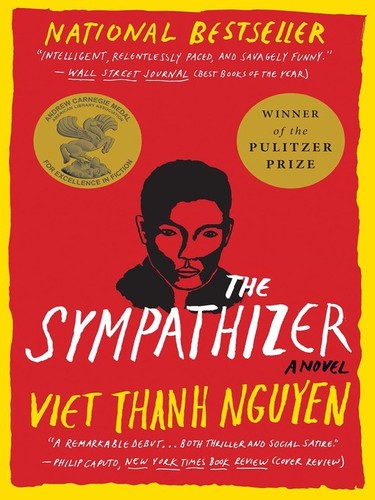
The Sympathizer
Viet Thanh Nguyen (2015)
“A Communist spy embedded in the South Vietnamese army confesses everything — but to whom, and why, you won't know until the end.”
Language Register
Elevated literary prose with ironic distance — postcolonial English that knows its own history as a colonial language
Syntax Profile
Long, recursive sentences with embedded parenthetical clauses — the prose performs the narrator's two-mindedness structurally. Nguyen frequently uses semicolons to hold two opposed propositions in a single sentence rather than resolving them. The confessional address (writing to the Commandant) gives the prose a second register beneath the literary: the narrator is also always performing for an audience that wants a particular kind of truth.
Figurative Language
High — but concentrated in political and cultural analysis rather than nature. Nguyen's metaphors are institutional: colonialism is figured as an architectural structure you live inside, ideology as a lens that cannot see itself. The novel's figurative language is predominantly conceptual rather than sensory.
Era-Specific Language
Post-1975 Communist Vietnamese practice of ideological correction for former South Vietnamese military/government personnel; implies forced transformation, not mere instruction
Never named — his title is his entire identity in exile; the definite article signals both respect and irony
Hollywood director figure; the pretentious title signals Nguyen's satirical mode toward American cinema's self-seriousness
The novel's title is a triple pun: Communist sympathizer, one who sympathizes with everyone, and a pun on the confession's tone
The narrator's handler and childhood friend — named 'Man' to signal his archetypal function; 'Man' is also what the narrator must prove he is during reeducation
How Characters Speak — Class & Identity
The narrator
Shifts register fluently between Vietnamese, French-inflected English, and American vernacular — code-switching as survival skill and loss simultaneously
A man formed by multiple colonial and political languages, none of which is fully his own.
The General
Formal military diction even in civilian settings — addresses subordinates by rank, speaks of the war in present tense
Identity preserved by refusing to acknowledge defeat. The formality is both dignity and delusion.
The Auteur
Hollywood development-speak: 'vision,' 'truth,' 'the American experience of Vietnam' — language of creative authority that forecloses Vietnamese interiority
Cultural imperialism is not hostile — it is earnest. The Auteur genuinely believes in his own humanism.
Man
Minimal dialogue — Man speaks rarely and without irony; his language is the language of the revolution: clear, declarative, purposeful
True belief as the absence of self-questioning. Man is what the narrator was supposed to become.
Bon
Soldier's directness — short sentences, concrete nouns, no abstractions; grief expressed as action rather than reflection
A man for whom ideology has collapsed entirely into personal loss. He fights because his wife is dead, not because of any political principle.
Narrator's Voice
The unnamed narrator: sardonic, self-aware, confessional under coercion. He writes with the doubled consciousness of a man who knows his audience (the Commandant) wants one kind of truth and cannot help delivering another kind. The voice's most distinctive quality is its capacity to be genuinely funny about genuinely terrible things — which is presented not as coping mechanism but as a form of cognitive colonization: having been educated in French irony and American cynicism, he cannot fully access Vietnamese directness of grief.
Tone Progression
Saigon and Early LA (Ch. 1-3)
Sardonic, controlled, analytically distant
The narrator reports events with the detachment of a spy — precise, ironic, apparently in command. The two-mindedness is a professional asset here.
Hollywood and the Second Murder (Ch. 4-5)
Furious irony, controlled rage
The satirical register peaks. The narrator's impotence before American cultural power makes the irony sharper and more desperate.
The Mission and Reeducation (Ch. 6-8)
Deteriorating, fragmented, finally stripped
The sardonic distance collapses under pressure. The final confession approaches something the narrator might call sincerity, though he distrusts the word.
Stylistic Comparisons
- Nabokov's Lolita — unreliable confessional narration that implicates the reader in its performance
- Catch-22 — satirical treatment of war's institutional absurdity, sardonic tone covering genuine horror
- Things Fall Apart — colonized consciousness narrated from inside the colonial wound
Key Vocabulary from This Book
Notable words used in this text — click to see full definitions