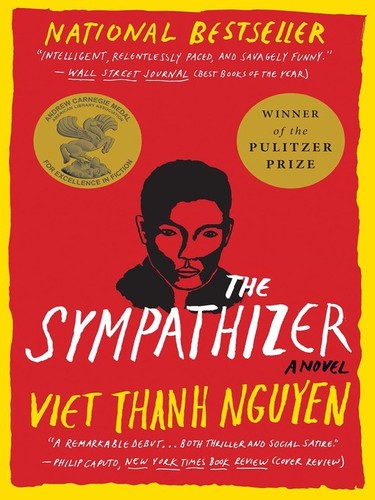
The Sympathizer
Viet Thanh Nguyen (2015)
“A Communist spy embedded in the South Vietnamese army confesses everything — but to whom, and why, you won't know until the end.”
Essay Questions & Food for Thought
30questions designed to challenge assumptions and provoke original thinking. These can't be answered from a summary — you need the actual text.
The narrator is never given a name. Why? What would change if we knew it?
The novel is structured as a confession written at the Commandant's order. How does this frame affect your reading? Are you the Commandant? The narrator's intended audience? Both?
The narrator says he is 'a spy, a sleeper, a spook, a man of two faces.' These four descriptions pile up without resolving. Why does Nguyen accumulate synonyms here rather than choosing one?
The Auteur gives the narrator two lines to distribute among all the Vietnamese characters in the film: 'Get out!' and 'Let's go!' Why these two lines? What do they reveal about how American cinema sees Vietnamese people?
Man, the narrator's Communist handler, is described as someone who never doubts. Is Man meant to be admired, criticized, or both? How does the novel use his certainty against the narrator's two-mindedness?
The narrator is complicit in two murders he opposed. Does he bear moral responsibility? Does his opposition matter if he executes the orders anyway?
How does the novel's treatment of Apocalypse Now (thinly veiled as The Hamlet) compare to the actual film? Is Nguyen's critique of American Vietnam War cinema fair?
The title The Sympathizer is a triple pun: Communist sympathizer, someone who sympathizes with everyone, and the emotional register of the confession. Which meaning does the novel ultimately privilege?
The reeducation camp scenes are the most harrowing in the novel. What exactly is being destroyed in the narrator — and is anything preserved?
Compare Bon and Man as the narrator's two friends. They represent opposite political positions. What is Nguyen saying about friendship that crosses ideological lines?
The Vietnamese extras in the Hollywood film are actual refugees being paid to perform their own people's suffering. How does this scene function as a critique? What makes it more disturbing than just pointing at a bad script?
The narrator describes France's colonization of Vietnam as a wound that produced both him and Man. Can colonialism explain his two-mindedness — or does that explanation let him off the hook?
Why does Nguyen make his protagonist a Communist spy rather than a straightforwardly sympathetic South Vietnamese refugee?
The novel ends with the narrator and Bon escaping toward the sea, refugees again, going somewhere. Why doesn't Nguyen give us a destination? What does the open ending mean?
The narrator's confession was written under coercion. The Commandant wanted a particular kind of truth. What truth did the narrator actually deliver — and is the novel itself that confession?
How does The Sympathizer use humor? Find three moments where the novel is funny. What are those moments funny about, and does the humor change how you process the horror?
The narrator can speak, read, and think in Vietnamese, French, and English. How do the three languages each carry different things — different emotions, different histories, different possibilities?
The General's exile community maintains military ranks and counterrevolution plans in a Los Angeles liquor store. Is this portrayed as absurd, tragic, admirable, or all three?
Compare the narrator's two murders. The first is botched and accidental in some ways. The second is deliberate and competent. How does the second murder change the narrator?
The novel won the Pulitzer Prize in 2016, the same year as a broader national conversation about representation in media (#OscarsSoWhite, etc.). Is the novel timely or timeless? Does its cultural moment help or hurt it?
The Congresswoman's aide has fully assimilated into American culture. The narrator has not. Who is more free? Who has lost more?
What does the novel mean by 'nothing' — the answer the reeducation camp finally extracts? Is it defeat, enlightenment, or both?
The novel depicts the Vietnamese reeducation camps, which held up to 300,000 people after 1975. How does knowing this history change your reading of the final section? What is the novel doing that a history book cannot?
If you were the Auteur, how would you respond to the narrator's criticisms? Is there a defense of The Hamlet that the novel doesn't give the Auteur a chance to make?
The novel is itself a Hollywood production now — an HBO series with a famous director. Does that adaptation change or confirm the novel's critique?
Bon is the narrator's oldest friend and also, ideologically, his enemy. How does Nguyen handle this without making Bon a villain or a fool?
Compare The Sympathizer to Apocalypse Now (or any American Vietnam War film you know). What does each work reveal about the war — and about whose suffering counts as the story?
The narrator was born to a French priest and a Vietnamese peasant woman. His origin is already colonial — he is the product of an unequal power relationship. How does this origin shape everything that follows?
Read the opening two paragraphs aloud. What does the rhythm of the prose — the sentence lengths, the semicolons, the accumulation of synonyms — tell you about the narrator before you've learned a single fact about his life?
By the end of the novel, who has the narrator betrayed? Make a list. Then argue: is there anyone he did NOT betray — and if so, why?