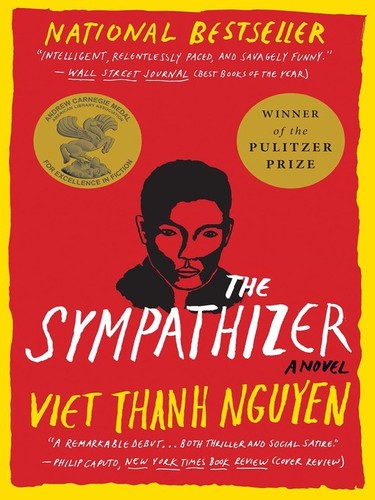
The Sympathizer
Viet Thanh Nguyen (2015)
“A Communist spy embedded in the South Vietnamese army confesses everything — but to whom, and why, you won't know until the end.”
The Sympathizer— Historical Context & Author Background
Author: Viet Thanh Nguyen · Published 2015· Era: Contemporary·371 pages
Themes explored: identity, duality, war, betrayal, ideology, memory, colonialism, performance
About Viet Thanh Nguyen
Viet Thanh Nguyen was born in Ban Me Thuot, Vietnam, in 1971 and fled to the United States with his family in 1975 following the fall of Saigon — when he was four years old. He was separated from his parents during the refugee processing period. Raised in Harrisburg, Pennsylvania, he became a professor of English and American Studies at USC. The Sympathizer was his debut novel. It won the Pulitzer Prize for Fiction in 2016, making Nguyen the first Vietnamese-American author to win the prize. He has said the novel is driven by his need to imagine what it would have felt like to have been old enough to understand what was happening in 1975.
Life → Text Connections
How Viet Thanh Nguyen's real experiences shaped specific elements of The Sympathizer.
Nguyen fled Vietnam as a four-year-old refugee and was temporarily separated from his family during processing
The novel's meditation on displacement, the loss of home, and the impossibility of full belonging anywhere
The narrator's two-mindedness is autobiographical at the deepest level — the experience of being formed by a country you left as a child.
Nguyen became a professor of English and American Studies — a Vietnamese scholar of American culture
The Hollywood satire and the narrator's analysis of American cultural imperialism
The Auteur chapters are written from inside the institution that produces American Vietnam War narratives — Nguyen knows exactly what he is critiquing.
Nguyen has written extensively about the Vietnamese-American experience of being caught between communities that each demand different allegiances
The narrator's impossible position as spy for both sides, belonging fully to neither
The sympathy that destroys the narrator is also the consciousness that allows Nguyen to write both sides with genuine understanding.
Historical Era
Vietnam War era and its aftermath (1955-1980), with particular focus on 1975 and the postwar diaspora
How the Era Shapes the Book
The novel is set at the exact historical moment when the American narrative of the Vietnam War was being constructed — and the Vietnamese narrative was being erased. Nguyen writes against every major American cultural artifact of the war: against Apocalypse Now, against Platoon, against the trope of the Vietnam War as an American tragedy. The reeducation camp history is largely unknown in American culture; the novel forces an American audience to encounter it.
Why The Sympathizer Matters Historically
First novel by a Vietnamese-American author to win the Pulitzer Prize for Fiction (2016). The Sympathizer broke into a literary tradition that had, for forty years, represented the Vietnam War almost exclusively through American protagonists. It shifted the center of gravity of an entire genre by telling the story from the Vietnamese side — and then complicating that by making the Vietnamese narrator also a Communist spy, refusing any simple moral reversal.
- First Vietnamese-American Pulitzer Prize winner in Fiction
- First major literary novel to critique the American Vietnam War film genre from a Vietnamese perspective
- One of the first American novels to give full interiority and narrative authority to a postcolonial Vietnamese character
- First novel to address reeducation camps as literary subject in major American publishing
Not widely challenged or banned; its difficulty and its graduate-level reading demands have kept it primarily in university curricula where academic freedom protections are stronger.