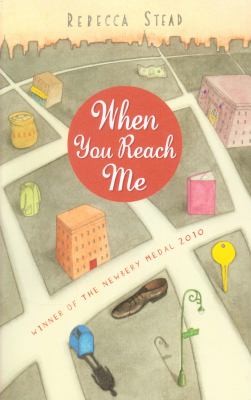
When You Reach Me
Rebecca Stead (2009)
“A sixth-grader in 1970s New York receives notes from the future — and has to figure out who sent them before it is too late to stop a death.”
When You Reach Me— Historical Context & Author Background
Author: Rebecca Stead · Published 2009· Era: Contemporary·199 pages
Themes explored: time, friendship, sacrifice, mystery, perspective, forgiveness, growing-up, connection
About Rebecca Stead
Rebecca Stead grew up in New York City and worked as a public defender before becoming a full-time writer. When You Reach Me won the Newbery Medal in 2010, the highest honor in American children's literature. Stead has described the novel as growing partly from her love of A Wrinkle in Time, which she read as a child and which forms the novel's central intertextual layer. The 1978 setting is the period of her own childhood, and the New York City of the novel — rougher, more economically precarious, more neighborhood-scaled — is drawn from memory.
Life → Text Connections
How Rebecca Stead's real experiences shaped specific elements of When You Reach Me.
Stead grew up in 1970s New York City as a middle-class child in a city that was more economically stratified and less gentrified than today
Miranda's small apartment, delivery job, and neighborhood life reflect the specific texture of working-class New York childhood in the era
The setting is not nostalgic but precise. Stead is rendering a specific social reality, not a golden-age childhood.
Stead read A Wrinkle in Time as a child and found its combination of realistic family life and impossible science fiction compelling
A Wrinkle in Time is Miranda's favorite book and the novel's structural model — both feature time travel as an emotional rather than merely scientific concept
The intertextual connection is not decorative. The novel argues that L'Engle's framework is the right one for understanding sacrifice and time.
Stead worked as a public defender, representing people whom the system tends to render invisible
Jimmy, the laughing man, is given full personhood rather than being used as a symbol or plot device
Stead's professional experience with invisible people informs how she writes about homelessness: with dignity, without condescension.
Historical Era
1978 New York City — post-fiscal-crisis, pre-gentrification, urban working-class life
How the Era Shapes the Book
The 1978 setting is not accidental nostalgia. It creates the conditions the novel requires: a child who navigates the city alone, a neighborhood with genuine economic precarity and visible homelessness, a world where children could spend time with adults outside their family without institutional supervision. The era's roughness is what makes Jimmy's presence on the corner unremarkable to everyone except Miranda.
Why When You Reach Me Matters Historically
Won the Newbery Medal in 2010. The Newbery is the most prestigious award in American children's literature, and When You Reach Me won it over a strong field. The win was seen as an endorsement of intelligent genre-blending — the novel is simultaneously a realistic middle-grade story, a mystery, and a science fiction novel, and the Newbery committee's choice signaled that these categories could coexist without compromising any of them.
- One of the few middle-grade novels to use a time-travel bootstrap paradox as a central structural device while remaining emotionally rather than mechanically focused
- A Newbery winner that centers science fiction concepts without being shelved primarily as science fiction
- A New York City novel that renders 1970s urban working-class life as the norm rather than as a problem to be overcome
Not widely challenged or banned. The novel's content is entirely appropriate for its target age range. It has faced occasional scrutiny for its depiction of homelessness, which some readers felt was insufficiently simplified for young audiences — though that concern rather proves Stead's point.