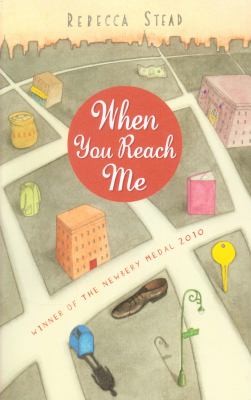
When You Reach Me
Rebecca Stead (2009)
“A sixth-grader in 1970s New York receives notes from the future — and has to figure out who sent them before it is too late to stop a death.”
Language Register
Informal but precise — a smart child's voice that notices details without performing observation
Syntax Profile
Short declarative sentences dominate. Miranda rarely uses subordinate clauses, preferring to state things plainly and then add qualifications in new sentences. This gives the prose a slightly halting, honest quality — like a child telling you something true who is also figuring out what it means as they speak.
Figurative Language
Low to moderate — Stead relies on precision rather than metaphor. When figurative language does appear, it tends to be in sensory observation rather than abstract comparison.
Era-Specific Language
Popular 1970s-80s school binder with colorful cover — period-specific detail signaling pre-digital schooling
Neighborhood sandwich shop with walk-up delivery trade — common 1970s New York City institution
Television quiz show — affordable entertainment and aspiration marker for working-class families in the era
Madeleine L'Engle's 1962 science fiction novel about time travel and sacrifice — Miranda's favorite book and the novel's intertextual key
How Characters Speak — Class & Identity
Miranda
Practical, observational, occasionally self-deprecating. Does not perform intelligence but demonstrates it through noticing.
Working-class urban kid with a reader's interior life. Her voice signals competence without social climbing.
Julia
More clipped and assertive than Miranda. Sets terms for interactions rather than following them.
Greater social confidence, possibly different class background. Julia knows she belongs, which gives her a directness Miranda does not quite have.
Marcus
Formal and abstracted — talks in complete thoughts, ignores social signals, treats ideas as more important than people's comfort.
A mind that operates outside social convention — neither upper-class nor lower-class speech, just genuinely strange.
Miranda's mother
Warm, competent, practical. Her intelligence comes through in the game show preparation — she is strategic and precise in a domestic register.
A capable single parent who has made a life through competence rather than connection. Her voice is like Miranda's but with more confidence.
Narrator's Voice
Miranda: retrospective child narrator who is smarter than she knows she is. Her plainness is not a limitation but a choice — she describes what she sees without interpretation, and the reader is invited to interpret alongside her. The retrospective frame means she knows the outcome but chooses to reconstruct the experience of not knowing.
Tone Progression
Opening sections
Observational, slightly melancholy, curious
Miranda is oriented outward, watching her world change without being able to stop it. The tone is quiet and attentive.
Middle sections
Tense, investigative, increasingly urgent
The mystery takes over and Miranda becomes more active. The prose is still plain but the stakes have risen.
Final sections
Resolved, elegiac, tender
Understanding has arrived. The prose becomes gentler and more retrospective. Miranda is writing to someone she loves across an impossible distance.
Stylistic Comparisons
- A Wrinkle in Time by Madeleine L'Engle — explicit intertextual model: same genre blend of realistic and fantastic, same emphasis on time and sacrifice
- From the Mixed-Up Files of Mrs. Basil E. Frankweiler by E.L. Konigsburg — same New York City child's-eye view, same pleasure in a cleverly constructed mystery
- The Watsons Go to Birmingham by Christopher Paul Curtis — comparable plain, warm prose voice calibrated to a young narrator
Key Vocabulary from This Book
Notable words used in this text — click to see full definitions