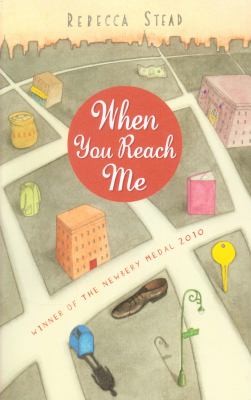
When You Reach Me
Rebecca Stead (2009)
“A sixth-grader in 1970s New York receives notes from the future — and has to figure out who sent them before it is too late to stop a death.”
Essay Questions & Food for Thought
30questions designed to challenge assumptions and provoke original thinking. These can't be answered from a summary — you need the actual text.
Miranda addresses her entire letter to someone she does not name until the end. How does knowing the letter has a specific recipient change how you read the book?
Why does Sal stop talking to Miranda after Marcus punches him? Why does Stead never give us Sal's point of view directly?
The novel is set in 1978 even though it was published in 2009. Why does Stead choose to set the story in the past? What does the era provide that the present could not?
Marcus punches Sal, which causes Sal to change his route, which is what puts him near the mail truck on the day of the accident. Is Marcus's punch evil, neutral, or good? Can a harmful act be part of a good outcome?
Compare A Wrinkle in Time, which Miranda loves, to When You Reach Me. In what ways is Stead writing a response to or continuation of L'Engle's ideas about time and sacrifice?
Why does Stead give the laughing man a name and a personality rather than leaving him as a background figure? What does the novel argue about invisible people?
The novel ends with Miranda completing the time loop by writing the letter. Does she have a choice about whether to write it? If the loop is already closed, is Miranda actually free?
Miranda's mother spends the novel preparing obsessively for the game show. How does her subplot connect to the novel's themes about preparation, knowledge, and acting without full information?
Why does Marcus, as a young person, talk about time travel theories to Miranda rather than to an adult or a teacher? What does Stead suggest about where important ideas get transmitted?
The novel asks you to accept time travel as real within its world. How does Stead make this believable without explaining the science? What makes it feel emotionally true rather than arbitrary?
How does friendship work differently in this novel than in most stories about friendship? What makes the Sal-Miranda friendship feel real rather than idealized?
Miranda begins keeping a journal because the notes tell her to. How does writing things down change how she sees her own life? Why might that be the most important instruction the notes contain?
What does the novel suggest about sacrifice? Jimmy gives his life for Sal. Was the sacrifice worth it? Does it matter whether Sal ever knows what Jimmy gave up?
How does Miranda's understanding of Marcus change over the course of the novel? At what point does she stop seeing him as the boy who hurt Sal and start seeing him differently?
The novel uses the first person throughout but structures itself as a letter. How does the letter format change the narrator's relationship to the reader? Who is the actual audience for this story?
Why does Stead set the climax on the same day as the game show? What does it mean that Miranda's mother wins on the day someone dies to save Miranda's friend?
Marcus hits Sal and years later dies to save him. If you were Sal and you knew this, how would you feel about the person who both hurt you and died for you? Does the novel ask you to resolve that contradiction or live with it?
Compare When You Reach Me to a mystery you have read or seen. What rules does a fair mystery follow? Does this novel follow them?
Miranda does not fully understand the notes until the very end. If she had understood them earlier, could she have changed what happened? Or was her not understanding part of how things had to work?
The novel's title, When You Reach Me, comes from the final letter. What does it mean to reach someone? How many different kinds of reaching does this novel contain?
Stead never tells us exactly how Marcus traveled back in time or what it cost him beyond his sanity and eventually his life. Why does she leave this unexplained?
Miranda loses her closest friendship at the beginning of the novel and gains several new ones by the end. Is this a fair trade? What does the novel suggest about how our social worlds shift as we grow up?
Marcus spent years or possibly decades trying to build a time machine in order to come back and save one person. Is that rational? Is it admirable? Is it both?
How does this novel use perspective — Miranda's limited perspective specifically — to create suspense? What information does Stead withhold from us by choosing Miranda as narrator?
The novel suggests that small actions can have enormous consequences across time. Can you think of examples from your own life or from history where a small act had unexpectedly large effects?
What does the novel suggest about forgiveness? Does Miranda forgive Marcus for what he did to Sal? Does the sacrifice make forgiveness easier or does it make it unnecessary?
How does living in a city — specifically 1970s New York City — shape Miranda's character and the novel's events? Would this story work in a suburb or a small town?
Miranda tells us she is writing the letter because someone asked her to write things down. How is keeping a record — whether a journal, a letter, or a story — an act of care toward someone else?
Stead won the Newbery Medal for this novel. The Newbery criteria include distinguished contribution to literature for children. What is the novel contributing — to literature, to readers, to the way we think about time and friendship?
If you could send a note back to yourself one year ago — knowing what you know now — what would you say? And would your past self believe you?