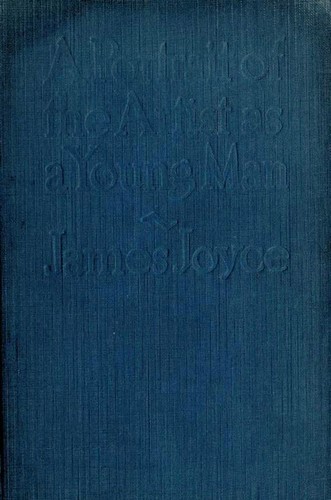
A Portrait of the Artist as a Young Man
James Joyce (1916)
“The novel that grew up with its hero — the prose literally evolves from baby talk to aesthetic philosophy as Stephen Dedalus forges a soul.”
A Portrait of the Artist as a Young Man— Historical Context & Author Background
Author: James Joyce · Published 1916· Era: Modernist·299 pages
Themes explored: identity, religion, art, rebellion, language, ireland, exile, consciousness
About James Joyce
James Augustine Aloysius Joyce (1882–1941) was born in Dublin to a Catholic middle-class family that, like the Dedaluses, declined steadily through his childhood as his father drank and borrowed and sold. He attended Clongowes Wood College on a scholarship, then Belvedere College, then University College Dublin — Stephen Dedalus's exact educational path. Like Stephen, Joyce rejected priesthood, rejected Irish nationalism, and left Ireland (with Nora Barnacle, who became his common-law wife) in 1904, never to return permanently. He wrote A Portrait of the Artist as a Young Man in Trieste, Zurich, and Paris, drawing directly on his journals and his own childhood. The early draft, called Stephen Hero, was abandoned; A Portrait emerged from the wreckage as a tighter, more formally daring work. Joyce spent the rest of his life in exile, producing Ulysses (1922) and Finnegans Wake (1939) while going slowly blind.
Life → Text Connections
How James Joyce's real experiences shaped specific elements of A Portrait of the Artist as a Young Man.
Joyce's father John was charming, alcoholic, politically opinionated, and financially ruinous — the family moved twelve times during Joyce's childhood
Simon Dedalus's drinking, nostalgia, and failure; the family's visible decline across the novel's five chapters
Stephen's alienation from his father is autobiographical — and informs his rejection of the nationalist pieties Simon represents
Joyce was pandied by a Jesuit at Clongowes and did complain to the rector, Father Conmee, who was sympathetic
The pandying scene and Stephen's visit to Father Conmee in Chapter One
The episode was not invented but lived — which makes its rendering in baby prose even more striking. Joyce chose to relive his own humiliation at its original scale of comprehension
Joyce rejected the Jesuit order's suggestion that he consider a priestly vocation
Chapter Four's interview with the director of Belvedere
The priestly option was a real alternative for men of Joyce's intelligence in Catholic Dublin. His rejection was genuine — and cost him family approval
Joyce left Ireland in 1904 with Nora Barnacle, wrote in exile for the rest of his life, and became increasingly hostile to the nationalist literary movement led by Yeats and others
Stephen's refusal of Davin's nationalism, his identification with Daedalus rather than Cuchulainn, his departure at the novel's end
Joyce's politics were aesthetics: he believed the only service an Irish artist could render Ireland was to tell the truth about it, which required leaving
Historical Era
Late Victorian / Edwardian Ireland, 1880s–1910s — under British rule, in the shadow of Parnell's fall, on the cusp of the Irish Revival
How the Era Shapes the Book
A Portrait is published in 1916, the year of the Easter Rising — a coincidence Joyce was aware of and which gives the novel's setting an eerie retrospective weight. Stephen's rejection of Irish nationalism reads differently knowing that the Rising was coming: the nationalism he refuses will shortly produce martyrs, and Joyce chose to remain the outsider. The novel embeds every major cultural force of late Victorian Ireland — Jesuit education, Parnellism, the Revival, the colonial linguistic wound — and measures them all against the individual consciousness trying to escape their gravitational pull.
Why A Portrait of the Artist as a Young Man Matters Historically
First published serially in The Egoist (1914–1915) and as a book in 1916, A Portrait established the free indirect discourse style that would define modernist fiction. It is the first major novel to make the prose itself perform consciousness — the style is not a frame around Stephen's mind, it IS his mind at each stage of development. The novel invented techniques that Virginia Woolf, William Faulkner, and every subsequent stream-of-consciousness writer would build on.
- First novel to use the prose register itself — vocabulary, syntax, sentence length — as a direct mirror of the protagonist's developmental age
- Established the 'epiphany' as a structural and narrative device in English fiction
- First major English-language novel to use free indirect discourse with such totality — the third-person narrator and the protagonist's consciousness are effectively identical
Challenged for obscenity (the prostitute encounter, the sexual passages) and for its treatment of Catholicism — specifically Chapter Three's hell sermons, which some read as mocking rather than faithfully rendering. The Egoist's printer refused to set certain sections. The novel was circulated in limited editions for years before wider publication.