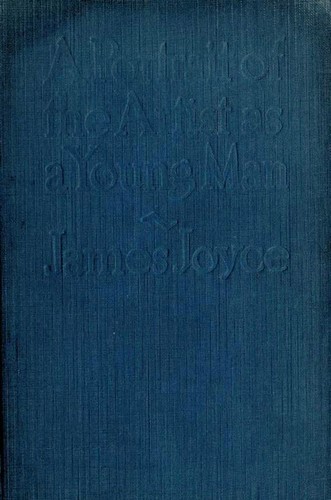
A Portrait of the Artist as a Young Man
James Joyce (1916)
“The novel that grew up with its hero — the prose literally evolves from baby talk to aesthetic philosophy as Stephen Dedalus forges a soul.”
Why This Book Matters
First published serially in The Egoist (1914–1915) and as a book in 1916, A Portrait established the free indirect discourse style that would define modernist fiction. It is the first major novel to make the prose itself perform consciousness — the style is not a frame around Stephen's mind, it IS his mind at each stage of development. The novel invented techniques that Virginia Woolf, William Faulkner, and every subsequent stream-of-consciousness writer would build on.
Firsts & Innovations
First novel to use the prose register itself — vocabulary, syntax, sentence length — as a direct mirror of the protagonist's developmental age
Established the 'epiphany' as a structural and narrative device in English fiction
First major English-language novel to use free indirect discourse with such totality — the third-person narrator and the protagonist's consciousness are effectively identical
Cultural Impact
The bildungsroman model it established — the artist as outcast-hero rejecting family, nation, and religion — influenced virtually every 'artist novel' of the twentieth century
The phrase 'silence, exile, and cunning' became a touchstone for artists and intellectuals who felt at odds with their own cultures
The Joycean epiphany entered critical theory and common speech as a term for sudden insight
Teaching staple in AP English, IB Literature, and university modernism courses worldwide
Stephen Dedalus reappears as a failed older version in Ulysses — one of literature's most self-critical gestures
Banned & Challenged
Challenged for obscenity (the prostitute encounter, the sexual passages) and for its treatment of Catholicism — specifically Chapter Three's hell sermons, which some read as mocking rather than faithfully rendering. The Egoist's printer refused to set certain sections. The novel was circulated in limited editions for years before wider publication.