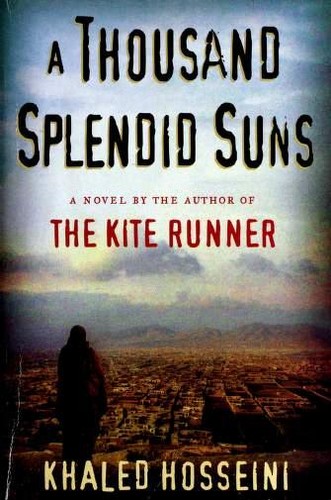
A Thousand Splendid Suns
Khaled Hosseini (2007)
“Two women in Kabul — born a generation apart, brought together by a cruel man, bound by a love that becomes the most radical act of resistance either can imagine.”
A Thousand Splendid Suns— Historical Context & Author Background
Author: Khaled Hosseini · Published 2007· Era: Contemporary Fiction·372 pages
Themes explored: gender, survival, sacrifice, love, war, resilience, family, hope
About Khaled Hosseini
Khaled Hosseini was born in Kabul in 1965. His father was a diplomat, and the family was living in Paris when the Saur Revolution and Soviet invasion made return impossible. They were granted political asylum in the United States and settled in California. Hosseini became a physician but had always wanted to write — The Kite Runner (2003) was his first novel, written in the hours before his medical shifts. A Thousand Splendid Suns (2007) grew from his desire to write about Afghan women, whose stories he felt The Kite Runner had not fully addressed. He has since become a UNHCR Goodwill Ambassador and dedicates significant resources to the Khaled Hosseini Foundation, which builds schools and clinics in Afghanistan.
Life → Text Connections
How Khaled Hosseini's real experiences shaped specific elements of A Thousand Splendid Suns.
Hosseini grew up in Kabul and left before the Soviet invasion — he carries a pre-war Kabul in his memory
The novel's repeated descriptions of Kabul's pre-Taliban beauty — the cinemas, the women in skirts at universities, the pomegranate trees
The novel's grief is partly autobiographical — mourning a Kabul that existed and was destroyed.
Hosseini's exile and distance from Afghanistan during its worst years
The retrospective quality of the narration — specific historical detail that requires research and distance to render precisely
The novel is written from outside the events it describes, which gives it the accuracy of documentation and the grief of exile.
His UNHCR work and advocacy for Afghan refugees
The novel's insistence on the humanity of individual Afghan women rather than their symbolic status
The political work and the literary work are the same project: making people visible who have been rendered invisible.
Historical Era
1970s–2003 — Afghanistan from monarchy through coup, Soviet invasion, mujahideen civil war, Taliban rule, and post-9/11 occupation
How the Era Shapes the Book
Each political transition in Afghanistan directly changes the material conditions of Mariam's and Laila's lives. The novel does not treat political history as background — it is the foreground. The women's private suffering is produced by and inseparable from the public catastrophe around them. Hosseini is arguing that there is no 'just a domestic story' when the domestic is regulated by state violence.
Why A Thousand Splendid Suns Matters Historically
A Thousand Splendid Suns debuted at number one on the New York Times bestseller list and remained on it for over a year. It sold over four million copies in the first year and has since become one of the bestselling novels of the 21st century. It arrived at a moment — 2007, during the US occupation of Afghanistan — when most Americans had never read a story set in Afghanistan from an Afghan perspective, and it introduced Afghan interiority to a mass audience.
- One of the first bestselling novels to center Afghan women's experience across five decades of political upheaval
- Brought the specific mechanics of Taliban gender policy to mass popular awareness
- Demonstrated that literary fiction with a female Afghan protagonist could reach the same commercial audience as Hosseini's male-centered debut
Challenged and removed from some school curricula for depictions of domestic violence, sexual content, and the Taliban's gender policy. Several challenges framed the book as politically biased against Islam — a misreading that conflates Taliban extremism with Islam as a whole, which the novel itself carefully distinguishes.