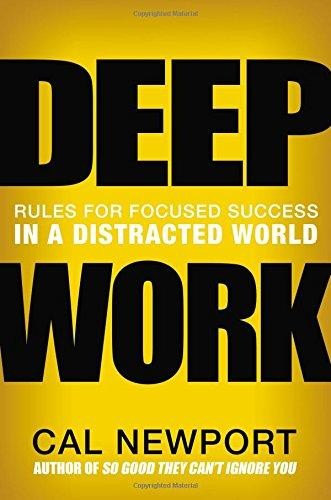
Deep Work: Rules for Focused Success in a Distracted World
Cal Newport (2016)
“A computer science professor argues that the ability to focus without distraction on cognitively demanding tasks is both the most valuable and the most rare skill in the modern economy.”
This page prints on a single page. Use Ctrl+P / Cmd+P.
Deep Work: Rules for Focused Success in a Distracted World
Cal Newport (2016) · 296pages · Contemporary Nonfiction
Summary
Cal Newport defines 'deep work' as the ability to focus without distraction on cognitively demanding tasks, argues that this capacity is becoming simultaneously more valuable and more rare in the modern economy, and provides a systematic framework for cultivating it. Drawing on examples from Carl Jung to J.K. Rowling, and combining cognitive science with practical strategy, Newport makes the case that deep work is not just a productivity technique but the foundation of a meaningful professional life.
Why It Matters
Deep Work crystallized a growing cultural concern about attention, distraction, and the quality of knowledge work into a coherent framework. It became one of the most influential productivity books of the decade and helped catalyze a broader movement toward 'digital minimalism' and intentional at...
Themes & Motifs
Diction & Style
Register: Moderately formal. Newport avoids contractions less than most popular nonfiction writers and maintains a professional distance from the reader. He rarely uses second-person address and almost never appeals to emotion. The formality signals seriousness — this is not motivational writing but analytical argument.
Narrator: Authoritative, slightly austere, occasionally wry. Newport positions himself as an observer of professional culture w...
Figurative Language: Low. Newport's prose is almost aggressively literal
Historical Context
The attention economy and smartphone era (2010s): Deep Work was published at a moment when the smartphone and social media revolution was mature enough to be visible but recent enough to feel reversible. The book captures a specific cultural anxie...
Key Characters
Talking Points
- Newport defines deep work as 'professional activity performed in a state of distraction-free concentration.' Is this definition too narrow? What kinds of valuable work might it exclude?
- Evaluate Newport's four depth philosophies (monastic, bimodal, rhythmic, journalistic). Which would work best for a high school or college student, and why?
- Newport argues that 'busyness is a proxy for productivity.' What does he mean, and can you identify examples of this pattern in your own academic or professional experience?
- How does Newport use historical examples (Carl Jung, Mark Twain, Charles Darwin) to support his argument? What are the strengths and weaknesses of using historical figures as evidence for a modern productivity framework?
- Newport connects deep work to Csikszentmihalyi's concept of 'flow.' How does this connection strengthen his argument beyond pure productivity? What does it suggest about the relationship between focused work and human wellbeing?
Notable Quotes
“Deep work is the ability to focus without distraction on a cognitively demanding task.”
“To learn hard things quickly, you must focus intensely without distraction.”
“Busyness as a proxy for productivity: In the absence of clear indicators of what it means to be productive, many knowledge workers turn toward an i...”
Why Read This
This book addresses the defining challenge of your generation: how to do meaningful cognitive work in an environment designed to fragment your attention. The strategies Newport provides — scheduling focus time, training concentration, evaluating d...