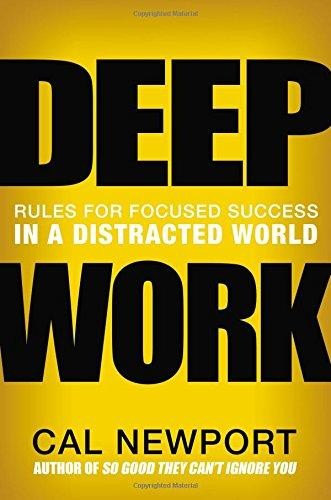
Deep Work: Rules for Focused Success in a Distracted World
Cal Newport (2016)
“A computer science professor argues that the ability to focus without distraction on cognitively demanding tasks is both the most valuable and the most rare skill in the modern economy.”
Deep Work: Rules for Focused Success in a Distracted World— Diction & Style Analysis
Language Register
Moderately formal. Newport avoids contractions less than most popular nonfiction writers and maintains a professional distance from the reader. He rarely uses second-person address and almost never appeals to emotion. The formality signals seriousness — this is not motivational writing but analytical argument.
Syntax Profile
Clean, declarative sentences that build arguments through logical sequence rather than rhetorical flourish. Newport favors the structure 'claim — evidence — implication,' repeating it at paragraph and chapter level. Sentences are medium-length and syntactically simple, avoiding subordinate clauses and parenthetical digressions.
Figurative Language
Low. Newport's prose is almost aggressively literal — he defines terms precisely, avoids metaphor, and lets his examples do the illustrative work. When figurative language appears, it tends toward industrial metaphors: 'deep work is the engine,' attention is 'fuel,' concentration is 'a muscle.' This austerity is itself a stylistic statement — the prose models the focus it advocates.
Era-Specific Language
Professional activity performed in a state of distraction-free concentration
Non-cognitively demanding, logistical-style tasks performed while distracted
Cognitive performance degradation from task-switching
Evaluating tools based on contribution to core professional goals
How Characters Speak — Class & Identity
Knowledge workers
Default audience — assumes readers have professional autonomy and cognitive work
The book's advice applies primarily to a professional class with significant control over their schedules; its relevance to hourly workers, service workers, or those without schedule autonomy is limited
Historical exemplars (Jung, Twain, Darwin)
Drawn from elite intellectual and creative traditions
Newport's models of deep work are disproportionately wealthy, privileged individuals who could afford to withdraw from social obligations — a selection bias he doesn't fully address
Tech workers
Frequent examples from Silicon Valley
The book emerged from and speaks to the tech-adjacent professional class, where distraction culture and deep work capacity are both most acute
Narrator's Voice
Authoritative, slightly austere, occasionally wry. Newport positions himself as an observer of professional culture who has cracked a code that most participants are too busy to see. There is confidence bordering on certainty in his claims — a conviction that deep work is not one strategy among many but the correct strategy. This certainty energizes some readers and irritates others.
Tone Progression
Part One
Diagnostic and argumentative
Newport builds the case for deep work through economic, psychological, and philosophical arguments, maintaining the tone of an academic making a literature-based case.
Part Two, early rules
Prescriptive and systematic
The tone shifts from argument to instruction, with the organized precision of a technical manual.
Part Two, later rules
Polemical and challenging
The social media chapter takes on a combative edge, directly challenging assumptions most readers hold dear.
Stylistic Comparisons
- Tim Ferriss (The 4-Hour Workweek) — both address productivity, but Newport is more intellectual, less flashy, and more skeptical of shortcuts
- Mihaly Csikszentmihalyi (Flow) — Newport popularizes Csikszentmihalyi's research for a professional audience, trading depth of psychological analysis for actionable strategy
- Matthew Crawford (Shop Class as Soulcraft) — both celebrate craftsmanship and deep engagement, but Crawford writes as a philosopher and Newport as a strategist
- James Clear (Atomic Habits) — similar systematic approach to behavior change, but Clear focuses on habit formation while Newport focuses on attention architecture