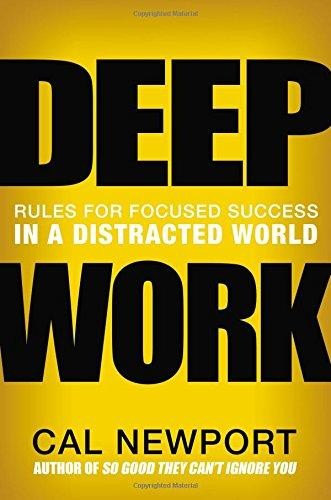
Deep Work: Rules for Focused Success in a Distracted World
Cal Newport (2016)
“A computer science professor argues that the ability to focus without distraction on cognitively demanding tasks is both the most valuable and the most rare skill in the modern economy.”
Deep Work: Rules for Focused Success in a Distracted World— Historical Context & Author Background
Author: Cal Newport · Published 2016· Era: Contemporary Nonfiction·296 pages
Themes explored: focus, distraction, productivity, craftsmanship, shallow-work, deliberate-practice
About Cal Newport
Cal Newport (born 1982) is a computer science professor at Georgetown University who has built a parallel career as one of the most influential thinkers on productivity, technology, and work in the 21st century. He earned his PhD from MIT in 2009 and has published academic research on distributed algorithms and computational theory alongside his popular books. Newport's background in computer science is not incidental to Deep Work — it shapes both the book's analytical framework (systematic, evidence-based, structured) and its argument (deep cognitive work is the scarce resource in an economy of abundant information). He has practiced what he preaches throughout his career: he has never had a social media account, he publishes academic papers at an elite rate, and he has written seven books — all while maintaining a strict daily schedule that ends work by 5:30 PM. Newport began writing about productivity and student success as a graduate student, publishing three books aimed at college students before transitioning to broader professional audiences with So Good They Can't Ignore You (2012) and Deep Work (2016). His subsequent books — Digital Minimalism (2019), A World Without Email (2021), and Slow Productivity (2024) — have continued to develop the themes introduced in Deep Work, building a comprehensive philosophy of attention, work, and technology.
Life → Text Connections
How Cal Newport's real experiences shaped specific elements of Deep Work: Rules for Focused Success in a Distracted World.
Newport has never had a social media account despite being a public intellectual
Rule 3 ('Quit Social Media') is not hypothetical — Newport lives the advice he gives
His personal practice gives the social media critique credibility that purely theoretical arguments would lack
Computer science professor producing elite-level academic research
The book's examples include Newport's own deep work practices — fixed schedule, no social media, ritualized concentration
Newport can point to his own productivity as evidence that the system works — he publishes papers, writes books, and stops working at 5:30 PM
MIT PhD in theoretical computer science
The book's structure reflects algorithmic thinking — define the problem, identify the constraints, optimize the system
Newport's technical training shapes the book's distinctively systematic, almost engineering approach to what is usually treated as a soft topic
Historical Era
The attention economy and smartphone era (2010s)
How the Era Shapes the Book
Deep Work was published at a moment when the smartphone and social media revolution was mature enough to be visible but recent enough to feel reversible. The book captures a specific cultural anxiety of the mid-2010s: the suspicion that constant connectivity was making knowledge workers less productive, less fulfilled, and less capable of sustained thought, but the difficulty of articulating that suspicion against the prevailing techno-optimism. Newport gave a name to something millions of professionals felt but couldn't define — and provided a framework for resistance that was systematic rather than nostalgic.
Why Deep Work: Rules for Focused Success in a Distracted World Matters Historically
Deep Work crystallized a growing cultural concern about attention, distraction, and the quality of knowledge work into a coherent framework. It became one of the most influential productivity books of the decade and helped catalyze a broader movement toward 'digital minimalism' and intentional attention management.
- Coined and popularized the term 'deep work' as a distinct category of professional activity
- Connected productivity research to philosophical arguments about meaning and craftsmanship
- Provided the first systematic, evidence-based framework for evaluating social media's professional costs and benefits
Not banned or formally controversial, but Newport's rejection of social media has been criticized as elitist — critics argue that his advice is only feasible for tenured professors and senior professionals who can afford to ignore networking platforms that are essential for people earlier in their careers or in less secure positions.