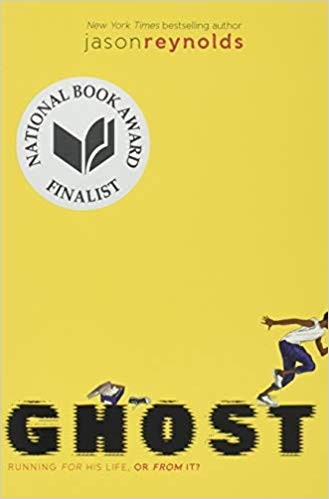
Ghost
Jason Reynolds (2016)
“A kid who can't stop running from his past discovers what it means to run toward something instead.”
This page prints on a single page. Use Ctrl+P / Cmd+P.
Ghost
Jason Reynolds (2016) · 180pages · Contemporary
Summary
Castle Cranshaw — self-named Ghost — is a seventh-grader living in a cramped apartment with his mother, haunted by the night his father fired a gun at them and went to prison. When Ghost sees a local track team practicing and impulsively outruns their fastest sprinter, Coach Brody recruits him on the spot. But Ghost's explosive anger and deep shame keep sabotaging his chances: he fights at school, lies about his background, and steals a pair of expensive sneakers to replace his battered high-tops. Coach gives him one final chance, and Ghost must decide whether he will keep running from his trauma or channel his raw speed into something that could save his life.
Why It Matters
Ghost was a National Book Award Finalist in 2016 and launched the Track series (Ghost, Patina, Sunny, Lu), which collectively became one of the most widely read middle-grade series of the decade. More importantly, it proved that literary fiction for young readers could center urban Black boyhood ...
Themes & Motifs
Diction & Style
Register: Conversational first-person, urban vernacular, accessible but precisely controlled
Narrator: Ghost narrates in first-person present tense with the immediacy of someone telling you a story on a park bench. He ad...
Figurative Language: Low by literary standards, high by middle-grade standards. Reynolds uses metaphor sparingly but precisely
Historical Context
Contemporary America — post-Great Recession, Black Lives Matter era, urban youth experience: Ghost was published in 2016, during a period when American culture was reckoning with the reality of Black childhood in ways it had historically avoided. The novel does not reference specific polit...
Key Characters
Talking Points
- Why does Reynolds open the novel with the shooting rather than building up to it? What does this structural choice communicate about how trauma operates in Ghost's life?
- Ghost carries a bullet casing in an Altoids tin. What is the symbolic function of this object, and how does Ghost's relationship to it change across the novel?
- Running operates as both literal activity and extended metaphor throughout the novel. Identify at least three distinct meanings 'running' carries and explain how Reynolds manages to hold them simultaneously.
- Why does Coach never yell at Ghost? How does Coach's quietness function differently from every other authority figure Ghost has encountered?
- Ghost steals the sneakers because he is ashamed of his old shoes. Does the novel excuse the theft, condemn it, or do something more complicated? Use evidence from the text.
Why Read This
Because Ghost sounds like someone you know — or someone you are. It is 180 pages long, which means you can actually finish it, and every page is doing something. The book does not talk down to you. It does not pretend that your life is simple. It ...