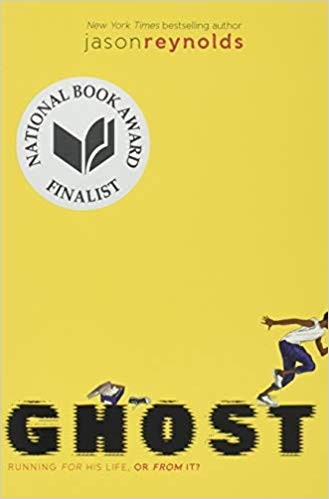
Ghost
Jason Reynolds (2016)
“A kid who can't stop running from his past discovers what it means to run toward something instead.”
Essay Questions & Food for Thought
30questions designed to challenge assumptions and provoke original thinking. These can't be answered from a summary — you need the actual text.
Why does Reynolds open the novel with the shooting rather than building up to it? What does this structural choice communicate about how trauma operates in Ghost's life?
Ghost carries a bullet casing in an Altoids tin. What is the symbolic function of this object, and how does Ghost's relationship to it change across the novel?
Running operates as both literal activity and extended metaphor throughout the novel. Identify at least three distinct meanings 'running' carries and explain how Reynolds manages to hold them simultaneously.
Why does Coach never yell at Ghost? How does Coach's quietness function differently from every other authority figure Ghost has encountered?
Ghost steals the sneakers because he is ashamed of his old shoes. Does the novel excuse the theft, condemn it, or do something more complicated? Use evidence from the text.
The novel ends on the eve of the race, not after it. Why does Reynolds choose not to show the championship? What argument is the ending making about what constitutes a 'victory' for Ghost?
How does Ghost's relationship to his name — Castle versus Ghost — reflect his internal conflict? When does he use which name, and what triggers the shift?
Compare Coach Brody to Ghost's father. Both are men who have failed. What makes Coach's failure recoverable where Ghost's father's was not?
Reynolds has said he writes for 'kids who look like me, who come from where I come from, who have been told that books aren't for them.' How is this mission visible in the novel's style — sentence length, chapter length, vocabulary, voice?
Ghost's mother is described almost entirely through action — working, sleeping in scrubs, making dinner. Why does Reynolds give her so little dialogue? What does this absence communicate?
Each member of the Defenders carries a private burden: Ghost's father, Lu's albinism, Patty's family pressure, Sunny's dead mother. Why does Reynolds assemble a team of wounded kids rather than a team of athletes?
The stolen sneakers are silver. Ghost's self-chosen name evokes speed and invisibility. Trace the imagery of silver/speed/disappearance through the novel and explain what it reveals about Ghost's self-concept.
Ghost knows an extraordinary number of world records. Why does Reynolds give him this obsession? How do the world-record facts function in the narrative — as character detail, as emotional regulation, or as something else?
How would Ghost's story be different if it were told in third person rather than first person? What would be gained and lost?
Reynolds never shows Ghost's father on the page in present time. Why is the father more powerful as an absence than he would be as a character?
Compare Ghost to The Outsiders by S.E. Hinton. Both are first-person narratives about boys navigating poverty, violence, and identity. How do the two novels differ in their treatment of class and belonging?
The diner scene — where Coach tells Ghost his own story — is the novel's emotional climax, not the championship. Why does Reynolds put the climax in a conversation about failure rather than in a moment of triumph?
Ghost lives in a neighborhood where Mr. Charles's store functions as a community hub. How does Reynolds use the store to counter narratives about urban decay? What kind of community does Ghost actually live in?
How does poverty function differently in Ghost than it does in, say, The Great Gatsby? In Gatsby, poverty is a condition to escape. In Ghost, it is a condition to survive within. Which treatment is more honest?
Reynolds chose to write a four-book series where each book centers a different teammate. What does this structural choice argue about the nature of individual stories versus community stories?
When Coach gives Ghost the legitimate running shoes, Ghost says they are not silver and not fancy — 'but they were mine.' Unpack the word 'mine' in this context. What does ownership mean for a boy who has had so little?
Ghost's anger is consistently described in physical terms — clenched fists, tight jaw, heat in the chest. Why does Reynolds keep the anger in the body rather than in the mind?
Is Coach Brody a savior figure? Does Reynolds fall into the 'mentor rescues troubled kid' trope, or does he complicate it? Defend your answer with evidence.
Ghost is rarely taught on AP exams or in college courses, despite being one of the most widely read novels of the 2010s. Why might literary institutions undervalue middle-grade fiction? What does Ghost offer that canonical texts do not?
The novel is set in a contemporary American city but never names the city. Why might Reynolds leave the location unspecified? What does geographic anonymity do for the story's universality?
How does Reynolds handle race in the novel? Ghost is Black, but the novel rarely makes his race an explicit subject. Is this a strength or a limitation?
Sunny runs because his dead mother was a runner. Ghost runs because he ran from a gun. Lu runs because he is competitive. Patty runs because she needs to be perfect. Which motivation is healthiest? Which is most sustainable? Does it matter?
Ghost says early in the novel that he knows 'a lot about a lot of things' — then proceeds to demonstrate that most of what he knows is world records and survival skills. What is Reynolds saying about the difference between knowledge and education?
The Altoids tin is described as a container for a bullet, but it is also a container for memory, identity, and grief. Compare Ghost's tin to another literary object that carries symbolic weight beyond its physical function.
If you were Ghost's teacher, what would you do differently than the teachers he describes in the novel? Reynolds presents school as a place that punishes Ghost's behavior without understanding its source. What would a trauma-informed response look like?