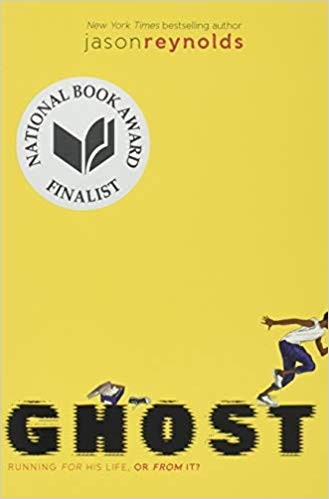
Ghost
Jason Reynolds (2016)
“A kid who can't stop running from his past discovers what it means to run toward something instead.”
Ghost— Summary & Analysis
by Jason Reynolds · published 2016 · 180 pages · Contemporary
A user-friendly study guide for Ghost by Jason Reynolds (2016): a high-level plot summary, full chapter-by-chapter analysis, theme breakdowns, character profiles, and 30 essay questions designed for middle-school readers. Unlike a stock summary, sumsumsum.com adds a diction analysis drawn from Jason Reynolds’s actual text, and reading-difficulty guidance (Easy, 1/10) so students, teachers, and lifelong readers know what they are walking into.
“A kid who can't stop running from his past discovers what it means to run toward something instead.”
Short Summary
Castle Cranshaw — self-named Ghost — is a seventh-grader living in a cramped apartment with his mother, haunted by the night his father fired a gun at them and went to prison. When Ghost sees a local track team practicing and impulsively outruns their fastest sprinter, Coach Brody recruits him on the spot. But Ghost's explosive anger and deep shame keep sabotaging his chances: he fights at school, lies about his background, and steals a pair of expensive sneakers to replace his battered high-tops. Coach gives him one final chance, and Ghost must decide whether he will keep running from his trauma or channel his raw speed into something that could save his life.
Detailed Summary
Castle Cranshaw lives with his mother in a small apartment in a rough neighborhood, working double nursing shifts to keep them afloat. Castle has exactly one talent the world has noticed: he can run. Not jog — explode. He discovered this the night his father, drunk and raging, fired a gun at Castle ...
Summary in the Author’s Writing Style
A retelling of Ghost in Jason Reynolds’s style — so you can hear the language, not just the plot. This is a stylistic pastiche written by sumsumsum, not an excerpt from the book.
Let me tell you something. I got a world record for you. The fastest a human ever ran was nine point five-eight seconds, a hundred meters, a man named Usain. I know stuff like that. I keep it in my head for when my head gets too loud. My head gets loud a lot. My real name is Castle Cranshaw, but e…
If you liked Ghost, read next
Start with The Crossover by Kwame Alexander — Same fusion of athletics and emotional complexity in middle-grade fiction — Alexander uses verse where Reynolds uses compressed prose, both centering Black boyhood. Then try The Outsiders by S.E. Hinton — First-person voice of a smart, marginalized boy navigating class, violence, and belonging — written half a century earlier but structurally a direct ancestor. Or pivot to Monster by Walter Dean Myers — The novel Reynolds has cited as his awakening — another story of a Black boy trapped in a system that has already decided who he is.
More from Jason Reynolds and the scholars who study Reynolds
Other works by Jason Reynolds: Long Way Down (2017, 306 pages). Reading two or three of these in sequence reveals Jason Reynolds’s recurring obsessions and stylistic signatures more clearly than any single book can.