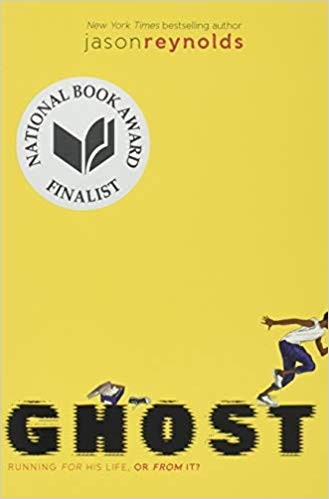
Ghost
Jason Reynolds (2016)
“A kid who can't stop running from his past discovers what it means to run toward something instead.”
Ghost— Historical Context & Author Background
Author: Jason Reynolds · Published 2016· Era: Contemporary·180 pages
Themes explored: trauma, running, identity, poverty, anger, mentorship, potential, second-chances
About Jason Reynolds
Jason Reynolds (born 1983) grew up in Washington, D.C., in the Oxon Hill neighborhood of Maryland — a working-class, predominantly Black community. He did not read a novel for pleasure until he was seventeen, when he discovered the poetry of Queen Latifah and later the fiction of Walter Dean Myers. That late entry into reading shaped everything about his career: he writes explicitly for the kids he was, the kids who see books as homework rather than pleasure. He became the National Ambassador for Young People's Literature in 2020, and his central mission — making literature feel like a conversation rather than an obligation — is embedded in every stylistic choice Ghost makes.
Life → Text Connections
How Jason Reynolds's real experiences shaped specific elements of Ghost.
Reynolds grew up in a neighborhood where running was sometimes literal survival — outrunning danger was a life skill
Ghost's foundational experience: running from his father's gunfire, speed as survival mechanism
Reynolds is not imagining Ghost's world from outside; he is reconstructing it from memory. The authenticity of the running-as-survival metaphor comes from lived experience.
Reynolds did not read a book for pleasure until age 17, convinced that books were not for kids like him
Ghost's short chapters, immediate voice, and accessible vocabulary — designed for reluctant readers
The novel's style is an ethical argument: every kid deserves a book that respects their attention and their intelligence. The brevity is not a concession; it is a conviction.
Reynolds has spoken about growing up with absent or inconsistent male figures and the impact of mentors who showed up
Coach Brody as surrogate father figure — reliable, quiet, present
Coach is drawn from the composite memory of men who showed up for Reynolds. The character is not idealized; he is scarred. That is what makes him credible.
Reynolds attended the University of Maryland and discovered writing through poetry before turning to fiction
The poetic compression of Ghost's prose — every sentence load-bearing, no filler
Reynolds's training as a poet explains why Ghost reads fast without feeling thin. The prose is compressed, not simplified. Each word earns its place.
Historical Era
Contemporary America — post-Great Recession, Black Lives Matter era, urban youth experience
How the Era Shapes the Book
Ghost was published in 2016, during a period when American culture was reckoning with the reality of Black childhood in ways it had historically avoided. The novel does not reference specific political events, but its portrait of a Black boy navigating poverty, trauma, incarceration's aftermath, and institutional indifference is inseparable from that cultural moment. Reynolds writes Ghost not as a problem to be solved but as a person to be known — a distinction that was and remains radical in middle-grade publishing.
Why Ghost Matters Historically
Ghost was a National Book Award Finalist in 2016 and launched the Track series (Ghost, Patina, Sunny, Lu), which collectively became one of the most widely read middle-grade series of the decade. More importantly, it proved that literary fiction for young readers could center urban Black boyhood without either sanitizing or sensationalizing it — and that reluctant readers would engage with a book that treated them as intelligent.
- One of the first middle-grade novels to center trauma-informed characterization without clinical language
- Pioneered the 'short chapter, immediate voice' style that has since become standard in diverse MG fiction
- Launched a four-book series where each volume shifts protagonist, creating a community portrait from individual stories
Challenged in some school districts for language (mild profanity), depictions of domestic violence, and the shoplifting scene. Defenders note that the challenges mirror the novel's own theme: discomfort with the realities of urban childhood that the book insists on making visible.