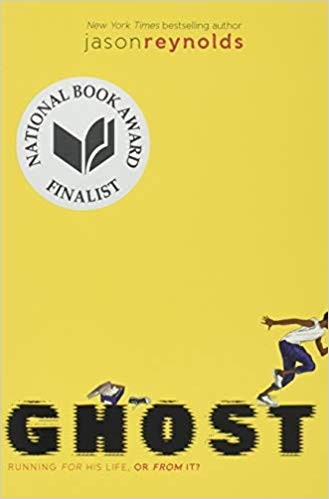
Ghost
Jason Reynolds (2016)
“A kid who can't stop running from his past discovers what it means to run toward something instead.”
Language Register
Conversational first-person, urban vernacular, accessible but precisely controlled
Syntax Profile
Short sentences, sentence fragments, direct address to the reader. Reynolds averages 8-12 words per sentence — roughly half of most literary fiction. Paragraphs rarely exceed four sentences. This compression is deliberate: it mirrors the pace of a sprinter's breathing and respects the attention patterns of reluctant readers.
Figurative Language
Low by literary standards, high by middle-grade standards. Reynolds uses metaphor sparingly but precisely — running as escape, shoes as identity, the Altoids tin as trauma container. When figurative language appears, it lands hard because it is rare.
Era-Specific Language
Basketball-style sneakers — status symbol and class marker among urban youth
Small metal container repurposed as memory vessel — Ghost's portable reliquary
Ghost's running list of world records — his way of processing aspiration through facts
Sunny's signature snack, adopted by the team — communal habit as bonding ritual
The track team's name — defensive positioning as identity for kids who have had to defend themselves
How Characters Speak — Class & Identity
Ghost (Castle Cranshaw)
Urban vernacular, dropped g's, sentence fragments, bravado masking vulnerability. Shifts to shorter, more guarded syntax around authority figures.
A smart kid who has learned that sounding too educated makes you a target, and sounding tough keeps you safe. His intelligence leaks through despite the armor.
Coach Brody
Direct, economical, low-volume. Uses questions more than statements. Never raises his voice.
A man who has earned his authority and does not need to perform it. His quiet speech is the opposite of every loud male figure in Ghost's life.
Ghost's mother
Warm but exhausted. Practical language — instructions, reminders, logistics. Rarely has time for extended conversation.
Love expressed through action rather than language. Her speech is compressed by time poverty — she literally does not have the hours for long talks.
Lu
Loud, confident, slang-heavy, performatively cool. Speaks in longer sentences than Ghost because he has more social security.
Economic stability translates to verbal freedom. Lu can afford to be expansive because he is not bracing for attack.
Narrator's Voice
Ghost narrates in first-person present tense with the immediacy of someone telling you a story on a park bench. He addresses the reader directly, uses 'let me tell you' as a framing device, and digresses into world-record facts when emotions become too intense. The digressions are not random — they are emotional regulation strategies disguised as trivia.
Tone Progression
Chapters 1-2
Guarded, bravado-heavy, defensive
Ghost introduces himself with armor on. The voice is tough, funny, and hiding enormous pain behind rapid-fire narration.
Chapters 3-5
Cautiously hopeful, competitive, curious
The team and Coach introduce possibility. Ghost's voice softens slightly as he begins to trust the structure around him.
Chapters 6-7
Desperate, ashamed, exposed
The stolen sneakers arc strips Ghost's armor. The voice becomes more fragmented, more honest, less performative.
Chapter 8
Quiet, steady, open
The calmest prose in the novel. Ghost's voice has room in it that was not there before. The defensive wit remains, but the terror underneath has receded.
Stylistic Comparisons
- Walter Dean Myers — Same commitment to urban Black boyhood, more formal prose, equally unflinching
- S.E. Hinton (The Outsiders) — Same class consciousness, same first-person immediacy, different era and dialect
- Kwame Alexander (The Crossover) — Similar athletic-literary fusion, Alexander uses verse where Reynolds uses compressed prose
Key Vocabulary from This Book
Notable words used in this text — click to see full definitions