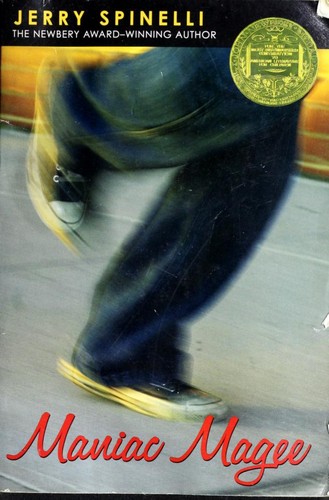
Maniac Magee
Jerry Spinelli (1990)
“A homeless boy runs from racial division, homelessness, and grief -- and becomes a legend neither side of town can explain.”
This page prints on a single page. Use Ctrl+P / Cmd+P.
Maniac Magee
Jerry Spinelli (1990) · 184pages · Contemporary / American Realism
Summary
Jeffrey Lionel Magee, orphaned at age three and renamed 'Maniac' by a town that turns him into legend, runs away from his unhappy relatives and ends up in the racially divided town of Two Mills, Pennsylvania. He crosses the unofficial color line that separates the black East End from the white West End, befriends Amanda Beale, lives briefly with the Beales, then with elderly Grayson at the baseball equipment room, and finally tries to make a permanent home with the McNab family. Every home falls apart. Every time, Maniac runs. The novel ends with him finally stopping -- choosing home with the Beales.
Why It Matters
Winner of the 1991 Newbery Medal, the highest honor in American children's literature. One of the first widely read middle-grade novels to place racial integration at the center of its plot rather than as background context. Has been taught in American schools continuously since publication and i...
Themes & Motifs
Diction & Style
Register: Informal, conversational, storytelling voice -- reads like a neighbor recounting a local legend
Narrator: Third-person omniscient with a community-narrator quality -- the voice sounds like the neighborhood telling its own s...
Figurative Language: Moderate -- Spinelli uses comparison sparingly but memorably. The legendary feats are described with comic hyperbole. When the prose turns serious (Grayson's death, Jeffrey leaving the Beales), the figurative language drops away almost entirely.
Historical Context
Late 1980s America -- post-Civil Rights Movement, ongoing residential segregation: Maniac Magee was published in 1990, at a moment when children's literature was beginning to grapple seriously with race. The novel's setting in a de facto segregated Pennsylvania town reflects the ...
Key Characters
Talking Points
- Spinelli opens the novel by saying 'it's hard to know where the legend ends and the truth begins.' Why does he frame the story as legend rather than realistic fiction? What does this framing allow him to do that straight realism wouldn't?
- Jeffrey doesn't understand why he can't cross Hector Street. Is his ignorance of the racial division naive, or is Spinelli making a larger point about how division is learned?
- Amanda Beale carries her books to school in a suitcase. What does this detail tell us about Amanda's relationship to books -- and to her family?
- Maniac earns his name through a series of feats -- untying Cobble's Knot, hitting McNab's pitches, catching touchdowns. He doesn't choose the name. Why is it important that the community gives him his legend rather than him claiming it?
- Why does Jeffrey leave the Beales even though they don't ask him to leave? Is his decision noble, self-destructive, or both?
Notable Quotes
“It's hard to know where the legend ends and the truth begins.”
“Tell your uncle I said he can salt his own food.”
“He was a kid. A raggy, skinny, dusty kid who blinked and looked around like he was seeing it all for the first time.”
Why Read This
Because it is a short novel that does enormous work. Maniac Magee is 184 pages and it covers homelessness, grief, race, literacy, the meaning of family, and what it costs to cross a line everyone else accepts. The prose is fast and funny and then,...