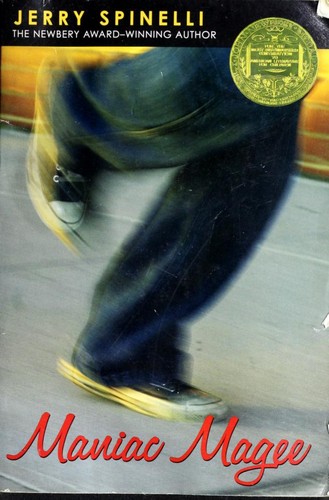
Maniac Magee
Jerry Spinelli (1990)
“A homeless boy runs from racial division, homelessness, and grief -- and becomes a legend neither side of town can explain.”
Essay Questions & Food for Thought
30questions designed to challenge assumptions and provoke original thinking. These can't be answered from a summary — you need the actual text.
Spinelli opens the novel by saying 'it's hard to know where the legend ends and the truth begins.' Why does he frame the story as legend rather than realistic fiction? What does this framing allow him to do that straight realism wouldn't?
Jeffrey doesn't understand why he can't cross Hector Street. Is his ignorance of the racial division naive, or is Spinelli making a larger point about how division is learned?
Amanda Beale carries her books to school in a suitcase. What does this detail tell us about Amanda's relationship to books -- and to her family?
Maniac earns his name through a series of feats -- untying Cobble's Knot, hitting McNab's pitches, catching touchdowns. He doesn't choose the name. Why is it important that the community gives him his legend rather than him claiming it?
Why does Jeffrey leave the Beales even though they don't ask him to leave? Is his decision noble, self-destructive, or both?
Grayson cannot read, but he once struck out Willie Mays twice in one game. How does Spinelli use Grayson's illiteracy and his baseball past to make a point about what literacy is and isn't?
Jeffrey teaches Grayson to read and Grayson teaches Jeffrey to pitch. Why does Spinelli make their relationship an exchange rather than a one-way gift?
Grayson dies peacefully on Christmas Eve, and Jeffrey covers him with a blanket and walks to the park. Why doesn't Spinelli write a longer grief scene? What does this restraint do to the reader?
The McNab house has a fort built inside it -- the boys are preparing for a race war they believe is coming. What is Spinelli saying about how children inherit their parents' fears?
Jeffrey organizes birthday parties for the McNab boys that include East End kids. Why does he do this? Does it work -- and what does 'working' even mean in this context?
Mars Bar Thompson is hostile to Jeffrey throughout the novel, but he saves Piper's life at the trestle. Spinelli does not explain why Mars Bar follows the group. Why might he leave this unexplained?
After watching Mars Bar save Piper, Jeffrey thinks he doesn't know 'what to do with what he'd seen.' What exactly has he seen that he can't process?
Spinelli never uses the word 'racism' in the novel. Is this a weakness -- a failure to name what he's describing -- or a deliberate choice? What does the absence of the word do?
The novel is set in Two Mills, Pennsylvania -- a fictional town based on Norristown, PA where Spinelli grew up. What does setting the story in a specific, geographically real-feeling place (rather than a generic 'small town') contribute?
Hector Street is never described as a racial boundary -- it's just described as where East End ends and West End begins. Why does Spinelli name it without labeling it? What would be different if a character explained 'this is where the black neighborhood ends and the white neighborhood begins'?
Jeffrey runs. He runs constantly. At what points in the novel is his running a strength, and at what points is it a failure? Is running ever the right response?
The Beales are a black family. Jeffrey is white. Spinelli makes the family that becomes Jeffrey's permanent home a black family. Is this a statement about race? Is it a statement about what family means? Can it be both?
Books appear everywhere in Maniac Magee -- Amanda's suitcase, Grayson's lessons, the books Jeffrey brings to the McNab boys. What is Spinelli saying about literacy? Is he being too optimistic about what reading can do?
Amanda comes to find Jeffrey in the band shell at the end -- she doesn't wait for him to find his way back. Why does Spinelli give Amanda this role rather than having Jeffrey decide on his own to return?
The last line of the novel is 'He was already there.' What are all the things this line means? How does the past tense change the meaning?
The novel has been challenged and banned in some school districts for its use of racial language in context. If a slur is used in a novel to show that it is harmful, is including it harmful? How do you think about this?
Compare the Beale household and the McNab household. What specific details does Spinelli use to differentiate them? Is the comparison fair to the McNabs?
Grayson is white; the Beales are black; the McNabs are white. Jeffrey, also white, finds his real home with the Beales. What is Spinelli saying about the relationship between race and belonging?
Maniac Magee won the Newbery Medal in 1991. By 1991 standards, was the novel's treatment of race progressive, conventional, or problematic? By 2026 standards, how do you evaluate it?
Huck Finn also crosses racial lines that adults enforce and befriends a Black man against social expectation. Compare Huck and Maniac. What does each friendship say about the child's society -- and about what children's literature thinks children can handle?
Spinelli never names the city, calls it Two Mills, and places it in a vague 'Pennsylvania.' Why fictionalize a place that is clearly based on a real city? What does the fictional name give the story that 'Norristown, PA' would not?
The legend-narrator voice at the beginning frames everything as community memory. By the end, does that voice feel reliable? Are there moments when the narrator seems to know more than a neighborhood could know?
Maniac fixes things -- Cobble's Knot, Grayson's illiteracy, the birthday party. He cannot fix everything: the racial division in Two Mills persists. Is the novel optimistic or realistic about what one person can change?
If Maniac Magee were set in your town today, what would Hector Street be? What are the boundaries in your community that people accept as natural but are actually learned?
Amanda Beale protects her books obsessively. By the end of the novel, she gives Jeffrey something more important than a book. What has she given him, and why is the gift bigger than anything with pages?