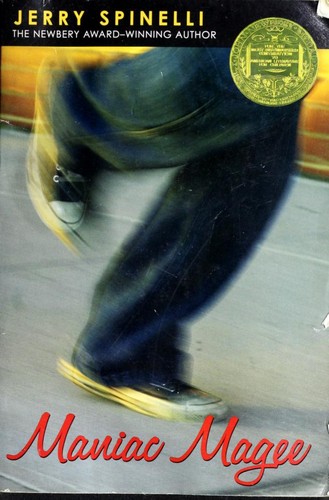
Maniac Magee
Jerry Spinelli (1990)
“A homeless boy runs from racial division, homelessness, and grief -- and becomes a legend neither side of town can explain.”
Language Register
Informal, conversational, storytelling voice -- reads like a neighbor recounting a local legend
Syntax Profile
Short declarative sentences dominate. Spinelli uses second-person address and present-tense legend-telling to create immediacy. Paragraphs are brief, often a single sentence. The rhythm is designed for reading aloud -- all oral, all forward motion.
Figurative Language
Moderate -- Spinelli uses comparison sparingly but memorably. The legendary feats are described with comic hyperbole. When the prose turns serious (Grayson's death, Jeffrey leaving the Beales), the figurative language drops away almost entirely.
Era-Specific Language
The nickname given by the neighborhood for extraordinary feats -- a legend-name, not a diagnosis
Geographic shorthand for racial division -- never called what it is, only where it is
Older slang used by Grayson -- signals his generational remove from the kids
The neighborhood game Jeffrey improves -- minor local slang that grounds the story in a specific place
The impossible-to-untie knot outside the corner store -- a proper noun for a neighborhood legend
How Characters Speak — Class & Identity
Jeffrey / Maniac
Speaks directly, without social performance. Does not adjust register for different characters. His voice is the same in the East End as in the West End.
Jeffrey's language is the most racially and class-neutral in the novel. He is outside all systems -- which is his superpower and his wound.
Amanda Beale
Direct, confident, a little bossy. Her language has the authority of someone whose books have given her a vocabulary for insisting on things.
Amanda is the most grounded character in the novel. Her voice does not perform class or race; it performs competence.
Grayson
Laconic, old-fashioned, slightly formal in a working-class way. Uses 'ain't' and clipped constructions. His language reflects limited education but not limited intelligence.
Grayson's illiteracy is not intellectual deficiency -- his speech is rich with observation. The gap between his spoken intelligence and his inability to read is the novel's point about what literacy is and isn't.
John McNab
Aggressive, declarative, territorial. His sons speak the same way -- language as challenge.
The McNab idiom is inherited resentment. The sons speak like the father because they have learned the same world.
Mars Bar Thompson
Terse, challenging, proud. Fewer words than anyone. His language is a guard.
Mars Bar's economy of language reflects the cost of showing vulnerability in the East End. He says the minimum. The trestle scene, where he speaks at length to save Piper, is the only time the guard drops.
Narrator's Voice
Third-person omniscient with a community-narrator quality -- the voice sounds like the neighborhood telling its own story. It shifts between documentary and tall-tale registers depending on whether it's describing legend or truth.
Tone Progression
Part 1 (Chapters 1-20)
Exuberant, comic, mythic
The legend builds. Feats accumulate. The prose is breathless with the pleasure of storytelling.
Part 2 (Chapters 21-34)
Tender, quiet, elegiac
The Grayson section. The pace slows. The comedy retreats. The novel allows itself to be still.
Part 3 (Chapters 35-46)
Melancholy, then resolving
The McNab attempt, the trestle, the running. The novel earns its ending through accumulated loss.
Stylistic Comparisons
- Huckleberry Finn -- another mythic American boy who crosses racial lines that adults maintain
- Charlotte's Web -- a children's novel that achieves genuine grief without manipulation
- The Outsiders -- Hinton's class-divided town compared to Spinelli's racially divided one
Key Vocabulary from This Book
Notable words used in this text — click to see full definitions