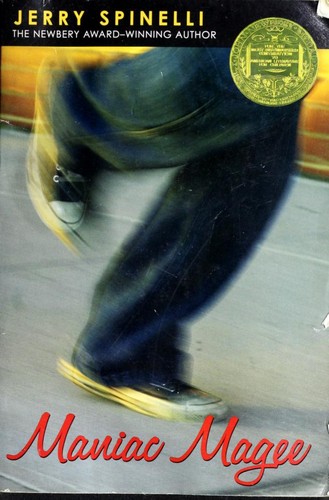
Maniac Magee
Jerry Spinelli (1990)
“A homeless boy runs from racial division, homelessness, and grief -- and becomes a legend neither side of town can explain.”
Maniac Magee— Summary & Analysis
by Jerry Spinelli · published 1990 · 184 pages · Contemporary / American Realism
A user-friendly study guide for Maniac Magee by Jerry Spinelli (1990): a high-level plot summary, full chapter-by-chapter analysis, theme breakdowns, character profiles, and 30 essay questions designed for middle-school, high-school readers. Unlike a stock summary, sumsumsum.com adds a diction analysis drawn from Jerry Spinelli’s actual text, and reading-difficulty guidance (Easy, 1/10) so students, teachers, and lifelong readers know what they are walking into.
“A homeless boy runs from racial division, homelessness, and grief -- and becomes a legend neither side of town can explain.”
Short Summary
Jeffrey Lionel Magee, orphaned at age three and renamed 'Maniac' by a town that turns him into legend, runs away from his unhappy relatives and ends up in the racially divided town of Two Mills, Pennsylvania. He crosses the unofficial color line that separates the black East End from the white West End, befriends Amanda Beale, lives briefly with the Beales, then with elderly Grayson at the baseball equipment room, and finally tries to make a permanent home with the McNab family. Every home falls apart. Every time, Maniac runs. The novel ends with him finally stopping -- choosing home with the Beales.
Detailed Summary
Jeffrey Lionel Magee is orphaned at age three when his parents die in a trolley accident. He is sent to live with his Aunt Dot and Uncle Dan in Hollidaysburg -- a miserable household where the two adults refuse to speak to each other and use Jeffrey as a go-between. At age eleven, during a school mu...
Summary in the Author’s Writing Style
A retelling of Maniac Magee in Jerry Spinelli’s style — so you can hear the language, not just the plot. This is a stylistic pastiche written by sumsumsum, not an excerpt from the book.
They say Jeffrey Magee was born in a dump. They say he had a rag for a diaper. They say. Listen. The truth is plainer, and the truth is worse. His mother and father went off a trolley trestle into the Schuylkill when the boy was three, and they sent him to live with an aunt and an uncle who hated e…
Chapter-by-Chapter Analysis
If you liked Maniac Magee, read next
Start with The Outsiders by S.E. Hinton — Class division in a small city, a protagonist who crosses social lines, and the question of whether bridges between groups are possible. Then try Hatchet by Gary Paulsen — A boy alone surviving on self-reliance -- but where Brian fights nature, Maniac fights the human landscape of prejudice and loss. Or pivot to Holes by Louis Sachar — Another Newbery-winning fable with a protagonist who seems impossibly unlucky and another who seems impossibly talented -- both are really about systemic injustice wearing the mask of individual fate.
For comparative essays, pair Maniac Magee with
The strongest comparative pairing is To Kill a Mockingbird (Harper Lee) — Racial division seen through a child's perspective -- but where Scout inherits her father's courage, Maniac arrives innocent of the rules entirely.
Each of these pairings opens a clean thesis path on shared themes, period diction, or formal influence — useful for AP Lit / IB / first-year college comparative essays.
More from Jerry Spinelli and the scholars who study Spinelli
Other works by Jerry Spinelli: Stargirl (2000, 186 pages). Reading two or three of these in sequence reveals Jerry Spinelli’s recurring obsessions and stylistic signatures more clearly than any single book can.