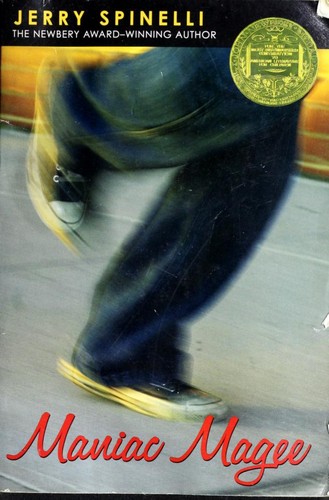
Maniac Magee
Jerry Spinelli (1990)
“A homeless boy runs from racial division, homelessness, and grief -- and becomes a legend neither side of town can explain.”
Maniac Magee— Historical Context & Author Background
Author: Jerry Spinelli · Published 1990· Era: Contemporary / American Realism·184 pages
Themes explored: race, belonging, legend, home, literacy, courage, community, prejudice
About Jerry Spinelli
Jerry Spinelli (born 1941) grew up in Norristown, Pennsylvania -- the real-world model for Two Mills. He has said that the racial geography of the novel reflects the actual division of Norristown when he was a boy. Spinelli won the Newbery Medal for Maniac Magee in 1991. He has noted that the character of Maniac emerged from his observation of a neighborhood kid who seemed fearless about crossing social boundaries that other children treated as absolute. Like Maniac, that kid never seemed to think the rules applied to him -- not out of defiance but out of genuine incomprehension.
Life → Text Connections
How Jerry Spinelli's real experiences shaped specific elements of Maniac Magee.
Spinelli grew up in Norristown, PA, a racially divided small city in the mid-twentieth century
Two Mills, Pennsylvania -- the geographic and social architecture of the novel is drawn from memory
The novel's specificity about neighborhood geography (Hector Street, East End, West End) comes from lived observation, not research.
Spinelli observed that children in his neighborhood largely accepted racial segregation as natural, without questioning it
Jeffrey's incomprehension of the Hector Street division -- he crosses it without drama because he doesn't know it's a wall
Jeffrey's ignorance of the rule is not stupidity but innocence. Spinelli uses it to defamiliarize a division adults have learned to see as permanent.
Spinelli's own complicated feelings about belonging and community in a working-class Pennsylvania town
The novel's insistence that community is built through acts of inclusion rather than geographic accident
The emotional argument of the novel -- that home is chosen -- reflects Spinelli's own observations about how belonging actually works.
Historical Era
Late 1980s America -- post-Civil Rights Movement, ongoing residential segregation
How the Era Shapes the Book
Maniac Magee was published in 1990, at a moment when children's literature was beginning to grapple seriously with race. The novel's setting in a de facto segregated Pennsylvania town reflects the Northern version of segregation -- not law-enforced but habit-enforced, which in many ways is harder to dismantle because there is no law to point to. Spinelli chose to address this through a child's-eye view, which allowed him to show the division as both real and absurd simultaneously.
Why Maniac Magee Matters Historically
Winner of the 1991 Newbery Medal, the highest honor in American children's literature. One of the first widely read middle-grade novels to place racial integration at the center of its plot rather than as background context. Has been taught in American schools continuously since publication and is one of the most assigned middle school novels in the United States.
- One of the first major middle-grade novels to use a white protagonist crossing into a black neighborhood as its central structural device
- One of the first Newbery winners to deploy fable and legend conventions to address contemporary racial division
- Pioneered the use of community-narrator voice in middle-grade realistic fiction
Has faced challenges and bans in multiple school districts, primarily for its portrayal of racial dynamics, its use of racial slurs (in context), and for what some parents have called 'a political agenda' regarding integration. The irony of banning a novel about the harm of division has not been lost on its defenders.