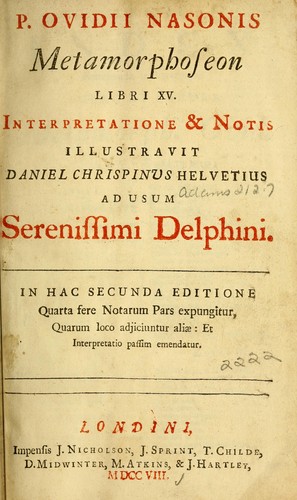
Metamorphoses
Ovid (8)
“The poem that taught Western civilization its mythology — 250 transformation stories woven into a single unbroken song from the creation of the world to the apotheosis of Julius Caesar.”
At a Glance
Ovid's Metamorphoses is a fifteen-book narrative poem in Latin hexameter that traces the history of the world from primordial chaos to the deification of Julius Caesar, threading together approximately 250 mythological stories through the unifying motif of transformation. Gods become animals, mortals become trees, hunters become stags, and weavers become spiders — every story pivots on a moment of irreversible change. The poem is simultaneously a compendium of Greco-Roman mythology, a subversive commentary on Augustan power, and the single most influential literary work on Western art, literature, and culture after Homer and the Bible.
Read full summary →Why This Book Matters
The Metamorphoses is, after Homer's epics and the Bible, the most influential literary work in Western civilization. It served as the primary vehicle through which classical mythology was transmitted to the medieval, Renaissance, and modern worlds. When Shakespeare wrote A Midsummer Night's Dream, when Bernini sculpted Apollo and Daphne, when Titian painted Diana and Actaeon, when Kafka wrote The Metamorphosis — they were all drawing on Ovid. The poem's survival through the Middle Ages (when it was allegorized as Christian moral instruction in the Ovide moralisé) ensured that Greek and Roman mythology remained a living cultural language throughout Western history.
Diction Profile
Latin hexameter ranging from Virgilian grandeur to colloquial wit — the most stylistically diverse poem in classical literature
Extremely high