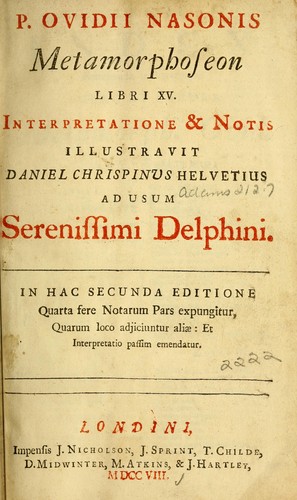
Metamorphoses
Ovid (8)
“The poem that taught Western civilization its mythology — 250 transformation stories woven into a single unbroken song from the creation of the world to the apotheosis of Julius Caesar.”
For Students
Because every myth you half-remember — Narcissus, Icarus, Pygmalion, Medusa, Orpheus — comes from this poem. The Metamorphoses is the source code of Western mythology. But it is not a dry catalogue of myths; it is a brilliant, witty, psychologically acute poem that treats transformation as the fundamental condition of existence. If you want to understand why Shakespeare wrote what he wrote, why Kafka named his most famous story what he named it, or why we still call self-obsession 'narcissism,' you need to read Ovid.
For Teachers
Infinitely teachable because infinitely modular. You can assign individual episodes (Narcissus for psychology, Arachne for art theory, Philomela for gender studies, Pythagoras for philosophy) or teach the whole poem as a study in narrative structure. The poem rewards close reading at every level — diction, imagery, structure, intertextuality — and connects to virtually every other text in the Western canon. It is the single most useful text for a comparative literature course.
Why It Still Matters
We live in an age of transformation — gender transition, digital identity, social media self-invention, climate change reshaping the physical world. Ovid wrote the definitive poem about what it means for things to change form, and his insights are as relevant now as they were in 8 CE. The Metamorphoses asks: When everything changes, what survives? Ovid's answer — art — is both a consolation and a challenge.